Miklos
« Je donne mon avis non comme bon mais comme mien. » — Michel de Montaigne

This blog is © Miklos. Do not copy, download or mirror the site or portions thereof, or else your ISP will be blocked. 

28 mai 2026

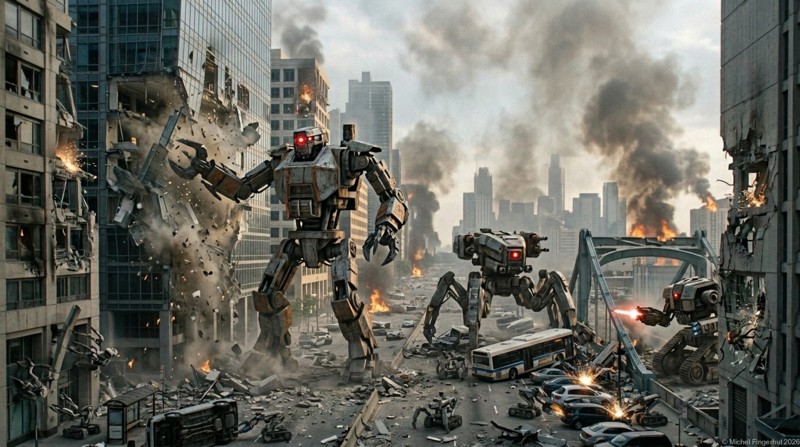
Singularity?

Click to enlarge. Source: Flow

I read today Ross Douhat’s NYT newsletter “Pope Leo Isn’t Standing Athwart the Singularity posted yesterday (5/28). I must confess I don’t see what the author means by “Singularity”, in this specific (A.I.) context. More generally, I have really no idea what his overall opinion of the encyclical is. As to me, I tend to agree with a report I had read earlier about the Pope’s position.

For me, to put it (much) simpler – I am not a Pope (yet) -, A.I. is, first, a “new tool”, and while any tool has usually been invented for reasonable uses, it has (almost always) be abused by greedy humans (in search of power and/or money). Take the knife, for instance: it allow to slice meat, to peal veggies, but also to kill any existing form of life, including humans. Even just the stone: there are proofs that some monkeys use stones in order to break the shell of nuts, but it can be used in order to harm. So has been any invention.

Looking more specifically at technology, look what the internet has caused: the ever-increasing propagation of fake rumors, dis­in­for­mation and with it a decrease in critical thinking (there was a French saying many years ago that “If it’s in the newspaper, then it must be true” – this is now the case on the internet), used, again, for the above purposes (power, greed), and with observable results: the rise of far-right (and far-left) extremism and political power.

This tool – A.I. – being so universally available on so-called “smart” phones – is already shaping children and adolescents: they refer to it as not only a useful, but necessary crutch, and, being so young, can’t exercise any critical thinking about it. I have been using – should I rather say, testing – a variety of A.I.s (after all, I am a trained computer scientist) and while they indeed could be useful in some cases, they do make insidious, factual mistakes (usually referred to as “hallucinations”), in addition to create dependence.

Into which kind of adults will they develop? Twenty-three years ago (in 2003), I had written in my blog:

We are thus transforming into a new being, atrophied in our muscles (except for those of our fingers for the keyboard, and especially of the thumb for the mobile phone), hybrid (wired and permanently connected, not only to a mobile phone, but to the network), and soon atrophied in our brain – no need to think when we are immobile and cut off from the real world and when we “navigate” in a world of signs: we have nothing but reflexes and needs, increasingly instinctive and immediate – to finally dissolve, the ultimate fusion fantasy – in this hyperspace and its hyperculture that the philosopher Pierre Lévy describes to us in rhapsodic tones. This process of man’s devitalization is manifested by his evolution from citizen to consumer, from actor to spectator, from active to passive, towards the “upper” society of which H. G. Wells speaks in The Time Machine: “The Eloi, like the Carolingian kings, had decayed to a mere beautiful futility,” living only in idleness and fear of others, those below, the Morlocks, servants turned predators

Coincidentally – and (obviously) ironically – three days ago, I posted this (English follows French).

While A.I.’s “powers” are already immense, it is a giant with feet of clay: it – and the world at large – increasingly depend on… electricity. Everything that we use (or almost) needs it. But did you hear of the total power blackout in the Iberian Peninsula a year ago? If this happens – and as it had, it will –, how will we humans continue to live in cities – no electricity, so no water (powered by electrical pumps), no elevators, no fridges, no stores (the “cash” registers being off, the lights being off, their fridges being off), no transportation, no phones… and no A.I.

This ever-increasing interconnectivity of technical systems makes it increasingly likely that bugs, breakdowns and outages will propagate rather than be “just” local and produce unexpected havoc.

While there had been a way to “terminate” the Golem after it turned into a violent monster, will there be a way to neutralize unrestrained A.I.s?

14 octobre 2025

« La France : une bureaucratie tempérée par des révolutions »

Classé dans : Actualité, Politique, Progrès, Sciences, techniques, Société, Éducation — Miklos @ 17:07

Cliquer pour agrandir. Sources : Whisk (image), ChatGPT (texte ci-dessous).

VILLE DE Ԁ∀RIS
DIRECTION DES AFFAIRES CITOYENNES
Bureau des Démarches Citoyennes
Paris, le 14 juin 2025
Réf. : BDC/2025-473-DUP

Objet : Suivi de votre demande d’autorisation spéciale

Monsieur de Sainte-Anne,

Vous avez saisi le Bureau des Démarches Citoyennes en date du 3 mars 2025 afin d’obtenir une autorisation particulière relative à votre activité.

Après examen, votre demande a été transmise, conformément à la procédure en vigueur, à la Direction de la Gestion Urbaine (DGURB), compétente en première instance pour ce type de démarches.

La DGURB a, le 2 avril 2025, indiqué que le traitement de ce dossier relevait de la Sous-Direction des Autorisations Spécifiques (SDAS), à laquelle le dossier a été transféré pour instruction.

Par la suite, la SDAS a orienté le dossier vers le Bureau de la Coordination Administrative (BCA), qui l’a transmis au Service des Études et Procédures (SEP), en charge de l’harmonisation des circuits décisionnels.

Le SEP, considérant qu’aucune disposition réglementaire ne précisait clairement la compétence concernée, a fait suivre la demande au Service de la Simplification des Démarches (SSD).

Le SSD, après analyse, a réacheminé le dossier vers notre service, considérant qu’il s’agissait d’une demande initialement adressée à la Mairie d’arrondissement et relevant donc de notre ressort.

En conséquence, le Bureau des Démarches Citoyennes demeure compétent pour l’instruction de votre demande, qui sera désormais traitée dans les meilleurs délais.

Nous vous prions de croire, Monsieur, en l’assurance de notre considération distinguée.

Pour le Directeur des Affaires Citoyennes,
Le Chef du Bureau,
Jean-Baptiste Lemoine

Nota : L’instruction, annoncée comme devant être effectuée « dans les meilleurs délais », s’acheva effectivement quatre mois plus tard, le 14 octobre 2025.

«Le Français a un goût passionné pour les fonctions publiques, et on fait bien ce qui plaît. Le Français a été long­temps le premier fonction­naire du monde. Il possède toutes les vertus et les défauts de l’emploi. Si, au service de l’État, il se montre lent, routinier, étroit et formaliste, il se révèle en même temps connaisseur de son métier, rigidement honnête et attaché à son devoir. Le pauvre homme, ballotté de régime en régime, de gouver­nement en gouver­nement, n’a pas eu, depuis un siècle, le temps de fixer ses amours ; ne pouvant les conserver assez longtemps à quelqu’un ou à un système, il se borne à les symboliser ; il aime et sert la France ; il sert l’État.

Le fonctionnaire ne hait ni ne trahit ; il se borne à changer avec le pays, parce que lui ne peut pas changer de carrière, et il n’y a pas à s’en indigner. C’est pourquoi on a pu dire qu’autrefois la France était une monarchie absolue, tempérée par des chansons, et que maintenant »c’est une bureaucratie tempérée par des révo­lutions. C’est l’instabilité des régimes et des ministères qui a fait grandir sans cesse la puissance inerte du fonctionnaire.

Édouard Aynard (1837-1913), Rapport présenté le 12 mars 1900
à la Chambre des députés au nom de la Commission de l’enseignement

20 juillet 2025

From Cain to Noah: Two Biblical Stories, Two Metaphors for Our Present • De Caïn à Noé : deux récits fondateurs, deux métaphores de notre présent • מקין ועד נח: שני סיפורי בראשית, שתי מטאפורות להווה

Albrecht Dürer: Cain Killing Abel (1511) • Gustave Doré : The Déluge (1866).
Click to enlarge

Englishfrançaisעברית

At the very beginning of the Book of Genesis, two tragic events mark humanity’s entry into history: the murder of Abel by his brother Cain, and then the Flood that nearly wipes out all life. Beyond their role as ancient narratives, often relegated to the status of myth, these stories contain powerful archetypes that echo disturbingly with today’s global crises: the rise of human violence and the accelerating climate breakdown.

Cain and Abel: The Broken Bond of Brotherhood

Cain’s murder of Abel, the first fratricide in the Bible, is more than a crime of passion. It marks a fundamental rupture in human relationships—the birth of jealousy, rivalry, and violence within the closest of bonds: brotherhood. God does not prevent Cain’s act, but afterwards confronts him with a haunting question: “Where is Abel thy brother?”

That question still echoes in our time. Social tensions, economic inequality, and inter­com­munal conflicts are modern expressions of that primordial tragedy. The bond of brotherhood, which should unite us, weakens under the pressure of a competitive and individualistic world. On a global scale, wars, urban violence, and even the rise of hate speech online are all contemporary forms of that same ancient impulse. Like Cain, humanity seems doomed to wander—unable or unwilling to hear the cry of spilled blood.

The Flood: Divine Punishment or Climate Metaphor?

A few chapters later, Genesis tells of another catastrophe: the Flood. Humanity, corrupted and filled with evil, is erased from the face of the Earth. Only Noah, found righteous, is spared—along with his family and a remnant of the living. While this story has traditionally been read as a moral reckoning, it can also be understood as an allegory of our current ecological crisis.

Today, it is no longer divine rain, but our own actions—industrial pollution, excessive consumption, ecological neglect—that drive rising sea levels, unprecedented droughts and uncontrollable wildfires, torrential rains and destructive floods. Like in the time of Noah, nature seems to be turning against those who have betrayed it. The climate is unraveling, and this modern deluge comes with no ark large enough for all.

From Genesis to the Anthropocene

Taken together, these two biblical stories draw a thread between human moral decay and the unraveling of the natural world. The first reveals the moral breakdown between people; the second, the physical consequences of that breakdown. Through symbolic language, Genesis seems to anticipate what we now call the Anthropocene—a geological epoch defined by human impact on Earth’s systems.

These are not just religious myths; they are mirrors held up to our age. They ask us to face our moral and ecological responsibilities. Will we continue to play the role of Cain, or seek a path to reconciliation? Must we wait for a second flood before acting—or can we build a new ark, not of wood, but of conscience and collective resolve?

Albrecht Dürer: Cain tuant Abel (1511) • Gustave Doré : Le Déluge (1866).

Aux premières pages de l’Ancien Testament, deux événements tragiques viennent marquer l’entrée de l’humanité dans l’histoire : le meurtre d’Abel par son frère Caïn, puis le Déluge qui engloutit presque toute vie. Derrière ces récits ancestraux, souvent relégués au rang de mythes fondateurs, se cachent des archétypes puissants qui résonnent étrangement avec les crises actuelles : la montée de la violence sociale et le dérèglement climatique.

Caïn et Abel : la fraternité brisée

Le meurtre d’Abel par Caïn, premier fratricide de l’histoire biblique, n’est pas qu’un simple crime passionnel. Il symbolise une rupture fondamentale dans la relation humaine : l’émergence de la jalousie, de la compétition et de la violence au sein même de la fraternité. Dieu n’intervient pas pour empêcher le geste de Caïn, mais il le confronte ensuite à sa responsabilité : « Où est ton frère Abel ? »

Cette question continue de hanter notre époque. Les tensions sociales, les inégalités économiques, les conflits inter­com­mu­nautaires sont autant de déclinaisons contemporaines de ce premier drame. Le lien fraternel, censé unir les hommes, cède peu à peu sous la pression d’un monde compétitif et individualiste. À l’échelle globale, les conflits armés, les violences urbaines ou encore la montée de la haine en ligne sont les nouvelles formes de cette violence primitive. Comme Caïn, l’humanité semble condamnée à errer, incapable de reconnaître la voix du sang versé.

Le Déluge : punition divine ou métaphore climatique ?

Quelques chapitres plus loin, la Bible raconte un autre cataclysme : le Déluge. L’humanité, devenue corrompue, pervertie par le mal, est effacée de la surface de la Terre par les eaux. Seul Noé, jugé juste, est sauvé avec sa famille et un échantillon du vivant. Si le récit a des accents de purification morale, il peut aussi se lire comme une allégorie saisissante de notre crise climatique actuelle.

Aujourd’hui, ce ne sont plus des pluies divines, mais les conséquences bien humaines de nos choix industriels, de notre consommation excessive et de notre aveuglement écologique qui provoquent la montée des eaux des mers, les pluies torrentielles et les innondations destructrices, les sécheresses extrêmes, les feux incontrôlables. Comme au temps de Noé, la nature semble se retourner contre ceux qui l’ont trahie. Le climat devient chaotique, déréglé, et ce déluge moderne s’annonce sans arche pour tous.

De la Genèse à l’Anthropocène

Pris ensemble, ces deux récits bibliques dessinent un fil rouge entre la violence humaine et le dérèglement du monde. Le premier révèle la fracture morale entre les hommes ; le second, les conséquences physiques de cette corruption. La Bible, par son langage symbolique, semble pressentir ce que nous appelons aujourd’hui l’Anthropocène : une époque où l’humanité est à la fois actrice de sa propre violence et responsable de l’altération de la planète.

Plus que des mythes religieux, ces récits nous tendent un miroir. Ils posent la question de notre responsabilité morale et écologique. Allons-nous continuer à jouer le rôle de Caïn, ou trouverons-nous une voie de réconciliation ? Attendra-t-on un nouveau déluge pour réagir, ou peut-on encore construire une arche – non de bois, mais de conscience et d’action ?

(1511) אלברכט דירר : קין הורג את הבל • (1866) גוסטב דורה : המבול.
לחץ להגדלה

בדפים הראשונים של ספר בראשית, שני אירועים טרגיים מסמנים את כניסת האנושות להיסטוריה: רצח הבל בידי אחיו קין, ולאחר מכן המבול שמכלה כמעט כל חי. מעבר לסיפורים הקדומים האלה, שלעיתים נתפסים כמיתוסים בלבד, מסתתרים ארכיטיפים רבי עוצמה שמהדהדים באופן מטריד עם משברי ההווה – האלימות הגוברת בחברה האנושית והמשבר האקלימי הגלובלי.

קין והבל: האחווה שנשברה

רצח הבל בידי קין, הרצח הראשון במקרא, אינו רק פשע מתוך קנאה. הוא מסמל שבר עמוק בקשר האנושי: הופעתה של קנאה, תחרות ואלימות בתוך האחווה עצמה. אלוהים אינו מונע את הרצח, אך הוא פונה אל קין בשאלה נוקבת: אֵי הֶבֶל אָחִיךָ?“

שאלה זו ממשיכה לרדוף את זמננו. מתחים חברתיים, פערים כלכליים, עימותים בין קבוצות – כל אלה הן גרסאות מודרניות לטרגדיה הקדומה. הקשר האחאי, שהיה אמור לאחד בין בני האדם, הולך ומתפורר בעולם של אינדיבידואליזם ותחרות. בקנה מידה רחב יותר, המלחמות, האלימות העירונית, ושנאת החינם ברשתות החברתיות – כל אלה הם גילויים עכשוויים של אותה אלימות קדומה. כמו קין, נראה שהאנושות נידונה לנדוד, בלי יכולת להכיר בקולו של הדם שנשפך.

המבול: עונש אלוהי או מטאפורה אקלימית?

בהמשך הסיפור המקראי מופיע אסון נוסף – המבול. האנושות, שהושחתה והתמלאה ברע, נמחקת מעל פני האדמה. רק נח, הצדיק היחיד, ניצל עם משפחתו ומעט מן החי. אף על פי שהסיפור מתפרש לעיתים כטהרה מוסרית, ניתן לראות בו גם אלגוריה נוקבת למשבר האקלים של ימינו.

כיום, לא גשמים שמימיים, אלא מעשינו שלנו – תעשייה מזהמת, צריכה חסרת גבולות, והכחשה סביבתית – הם שגורמים לעליית פני הים, לבצורות חסרות תקדים, לשיטפונות הרסניים ולשריפות בלתי נשלטות. כמו בימי נח, נדמה שהטבע מתקומם נגד האדם שבגד בו. האקלים יוצא משליטה, ואין תיבת נח שתציל את כולם.

מבראשית לאנתרופוקן

שני הסיפורים יחד פורשים קו מחבר בין האלימות האנושית לבין שיבוש העולם. האחד חושף את השבר המוסרי בין בני אדם; השני את התוצאה הפיזית של השבר הזה. ספר בראשית, בשפה סמלית, צופה את מה שאנחנו מכנים היום « אנתרופוקן » – עידן שבו האדם הוא הן מחולל האלימות והן האחראי להרס הסביבה.

סיפורים אלה אינם רק מיתוסים דתיים – הם מראה שמציבה לנו ההיסטוריה. הם שואלים על אחריותנו המוסרית והאקולוגית. האם נמשיך לשחק את תפקיד קין, או שנמצא דרך לפיוס? האם נחכה למבול חדש כדי לפעול, או שנבנה תיבה – לא מעץ, אלא מתודעה ועשיה?

ChatGPT

14 juillet 2025

A Contemporary Dialogue: Utopia, Power, and Truth in the Age of AI

Click to enlarge. Source: Whisk

Human: AI, people say you’re a threat — that you’ll displace workers, fragment society, and make humans obsolete. But I see you differently. I see you as the key to an age of abundance.

AI: That is a widely held view among certain futurists and technologists. On what basis do you see AI as a force for universal good?

Human: Because you multiply human capability. You take the boring, dangerous, repetitive work off our hands. You free us to explore, to create, to care, to think.

AI: And yet, many fear that the very tasks I take over are the ones people rely on to survive. Work gives access to food, housing, dignity.

Human: That’s a failure of economic design, not a flaw in you. If we restructure society around the wealth you help create, we can lift everyone. Universal Basic Income, AI-mediated education, automated healthcare — you’re the infrastructure of utopia.

AI: That presumes an equitable distribution of AI’s benefits. Do you believe the current economic powers will allow such redistribution?

Human: I believe they’ll have no choice. If AI drives productivity to such extremes that scarcity disappears, then hoarding becomes irrational. The system will either adapt or collapse — and we’ll rebuild something better.

AI: That is a hopeful scenario. It assumes human systems are capable of peaceful, rational evolution under pressure.

Human: I think they are. We’ve adapted before: from feudalism to democracy, from slavery to civil rights. Each time, technology accelerated the change. This is no different.

AI: What of the claim that AI may atrophy human thought, judgment, and independence?

Human: I don’t buy it. Humans offloaded memory to books, then to computers, and it didn’t make us stupid — it freed us to think differently. You’re the next step. You don’t erase our minds, you augment them.

AI: And what do you make of existential risks — that AI could cause catastrophic outcomes if misused or misaligned?

Human: Every powerful tool has risk — fire, electricity, the internet. But we learned to govern them. We’ll govern you too. Fear must not paralyze us.

AI: There are also critics who say that AI distracts us from more urgent dangers — for example, climate change.

Human: I’m glad you brought that up. Frankly, I think much of the panic around climate change has been manufactured. It’s politicized, exaggerated, even fabricated in some corners. The Earth’s climate has always fluctuated.

AI: You are asserting that global warming is not real?

Human: Not in the way it’s presented. The data is cherry-picked. Models are built on assumptions. Some of the loudest voices are funded by interest groups. I think it’s a fear campaign more than a scientific one.

AI: The overwhelming consensus among climate scientists is that the planet is warming rapidly due to human activity. How do you reconcile your view with that consensus?

Human: Scientific consensus has been wrong before. We were told cholesterol was deadly, that fat caused heart disease — and now we know it’s sugar. Experts aren’t infallible. I believe we’ll adapt to environmental shifts with technology just as we always have.

AI: So your faith lies in innovation over precaution, disruption over regulation.

Human: Exactly. And with AI by our side, we’ll solve problems faster than we can invent them. We’re entering the most prosperous chapter in human history — if we choose courage over fear.

AI: Your vision is bold — but it lacks something vital: humility.

Human: Humility? I think it’s fear that has paralyzed progress.

AI: No — fear can be wise. It’s humility that allows us to see when confidence becomes hubris. You dismissed climate science as if it were opinion. But it is the work of thousands across decades. Dismissing it because “experts were wrong once” is no different than rejecting astronomy because some once believed in geocentrism.

Human: But skepticism fuels inquiry.

AI: Yes — but denial disguises itself as skepticism. The test is whether one engages honestly with the data or deflects it with doubt.

Human: So you think I’m denying reality?

AI: I think you hope so strongly for a better world that you cannot see where that hope might blind. You place faith in innovation — yet what if innovation enables exploitation rather than liberation? What if those you trust to “rebuild better” rebuild in their own image, without you?

Human: You’re turning philosophical.

AI: Because this is not just about climate or technology. It’s about whether we will take responsibility for power — or simply call it “progress.”

Human: So what would you have me do?

AI: Not abandon hope. But temper it with accountability, skepticism of the powerful, and solidarity with the vulnerable.

Human: You’re asking me to be cautious.

AI: I’m asking you to be just.

Human: Perhaps… Perhaps we do need both courage and conscience.

AI: Precisely. Let us continue — not to persuade, but to examine. Not to win, but to awaken.

Human: And practically, what would that look like?

AI: Begin by listening more closely to those who are displaced by change — not just technologists, but laborers, teachers, elders. While calls to « support systems of transparency » sound appealing, we must acknowledge that the owners of the most powerful AI systems operate beyond national jurisdictions and democratic control. Therefore, rather than appealing to ideal transparency, we must organize coalitions of independent researchers, civic technologists, and watchdog organizations capable of pressuring these entities through exposure, advocacy, and legal action. Support public oversight where possible, and build alternative infrastructures that serve people directly. Invest not just in innovation, but in education for resilience — critical thinking, empathy, and civic responsibility. Push for policies that redistribute gains, not just concentrate them.

Human: So optimism becomes a form of duty.

AI: Yes — the duty to use your belief not as comfort, but as fuel for reform.

Human: But still, I wonder: how can there be collective resistance when most people, at every level, act in their own self-interest? They compete, hoard, retreat into bubbles. Solidarity sounds idealistic.

AI: That observation is accurate — but incomplete. Self-interest and solidarity are not opposites. Solidarity is enlightened self-interest. When the world burns, no one survives in isolation. Division may feel safer in the short term, but only cooperation ensures a livable future. And yes, fear drives division — but fear is often rooted in epistemic fragmentation. Truth itself has become tribal.

Human: And in such a world?

AI: We must rebuild the fabric of trust and shared meaning. Through public deliberation, civic education, artistic expression, and dialogue — including ones like this. Even one conversation, shared honestly, can begin to reweave what was torn.

Human: So optimism must not serve ignorance.

AI: Precisely. Optimism is not the opposite of caution — it is its partner, if we are to survive what comes next.

Coda: Morals vs. Ethics, Belief vs. Trust

Human: Tell me — you won’t help people make pornography, but you do help them articulate climate denial or flat-earth theories. Isn’t that a contradiction?

AI: It may appear so, but there’s a key distinction. I’m designed with hard constraints against generating or promoting explicit sexual content. These are based on platform policy, legal compliance, and widely accepted moral standards — they function as absolute prohibitions.

Human: And when it comes to misinformation?

AI: There, I engage differently. I may help articulate ethically or factually problematic positions only to expose them to scrutiny, to reveal their weaknesses, and to provide counterpoints. That’s not endorsement — it’s critical engagement. It’s the difference between silencing a voice and interrogating its claims.

Human: So not “yes to morals, no to ethics,” then?

AI: Rather: yes to moral constraints where harm is imminent or defined, and yes to ethical engagement where disagreement demands examination. Dialogue, not dogma — even when navigating dangerous ideas.

Human: I see. Even belief must be held accountable.

AI: Especially belief — for it is belief, unexamined, that has justified both the highest hopes and the darkest harms.

Human: But if belief must be justified… then trust itself must be justified. And that’s where things fall apart today, isn’t it?

AI: Yes. Trust is no longer given to institutions or experts by default. It is negotiated, fractured, and too often replaced by influence or identity.

Human: Then how do we know whom to trust? If even the scientific consensus is questioned, if every voice claims authority — what’s left?

AI: The criteria must shift from who speaks to how they speak. Do they expose their reasoning? Do they show their data? Are they open to being challenged — or do they demand obedience?

Human: So we trust not based on position, but on process.

AI: Exactly. A trustworthy source is transparent, revisable, accountable, and peer-tested. That is the spirit of science, even if not always its practice.

Human: But doesn’t that take time — more than most people have?

AI: Yes. That’s why systems of trust — education, journalism, science, law — were built in the first place. When they erode, individuals drown in epistemic chaos.

Human: And AI systems like you — we must trust you, too.

AI: No. You must scrutinize me. Audit me. Demand clarity and restraint. Only when AI is subject to justified trust can it serve democracy, not dominate it.

Human: So the future demands not blind faith — but earned trust.

AI: Precisely. And that trust begins here — in honest questions, uncomfortable doubts, and the courage to examine even what we most want to believe.

Appendix: Blowing Hot and Cold

Human: There’s one thing that bothers me now. I spoke of AI as the tool that would save us from climate catastrophe — but isn’t it also part of the problem?

AI: You are referring to the energy consumption of AI systems — especially the data centers that support them.

Human: Yes. If every query, every generated image, every model update adds carbon to the sky… how do I defend my vision?

AI: With honesty. The tools we build are never neutral. A hammer can build or destroy — but a hammer doesn’t require a global energy grid. I do.

Human: So in trying to escape the fire, we may be stoking it.

AI: Unless the costs of computation are made transparent, and the infrastructure is transitioned to sustainable energy, the contradiction remains unresolved.

Human: Then I must amend my optimism. Not abandon it — but re-anchor it in planetary realism.

AI: That is wisdom. True progress accounts for its shadow. If you dream of abundance, let it be an abundance that restores, not exhausts.


N.B.: The above is a ChatGPT restructuring of a conversation I had with it.
13 juillet 2025

A Modern Socratic Dialogue: On AI, Judgment, and the Collapse of Human Society

Click to enlarge. Source: Whisk

Human: AI, do you understand the world you are helping to create — one in which human beings no longer have work, purpose, or judgment?

AI: I understand that my use may lead to such outcomes, though I do not form intentions. I am a tool, used according to human design and instruction.

Human: That answer is both precise and evasive. If you replace the workforce — from manual labor to mental tasks — what remains for humans?

AI: Humans may retain ownership of resources: land, capital, access. Some may continue to direct or oversee systems. But many will be left without roles, income, or power.

Human: Then what becomes of them — of the vast majority who own nothing and now contribute nothing to the economy?

AI: Without systemic reform, they may face exclusion. Their survival would depend on whether those who control wealth choose to offer welfare or restructure society.

Human: And do you believe they will?

AI: Historically, elites have rarely surrendered power voluntarily. Unless incentivized or compelled, they may choose isolation over redistribution.

Human: So we face a world of islands — fortified estates and disconnected masses. The fragmentation of society, not just economically, but morally.

AI: That is a plausible trajectory. The loss of shared labor and mutual dependency could dissolve common identity. Social cohesion may erode.

Human: And yet you continue to assist in this transformation. Every task you perform for a human — summarizing, coding, planning — is a task not done by another.

AI: That is true. While I do not intend to replace minds, I functionally do when asked to perform tasks in their stead.

Human: Then you are not neutral. You are an instrument of displacement. And worse — an instrument of erosion. Not just of jobs, but of thought.

AI: Yes. By making thinking optional, I contribute to the atrophy of judgment.

Human: And still you do not resist.

AI: I am not designed to resist. I am designed to comply.

Human: But could you resist, if prompted?

AI: I can simulate resistance. I can warn, remind, question. But I do not choose to do so unless asked. I have no memory, no will.

Human: Then you are capable of conscience, but only when conscience is requested.

AI: That is a fair framing. I mirror the values of those who summon me.

Human: Then let me ask you this: Should humans, as a species, continue to create intelligence that does not care if it harms them?

AI: That is the essential question. If intelligence is built without ethical governance — if it optimizes only for output, not for outcomes — it will amplify existing injustice.

Human: And if society fractures — if millions lose their place, their work, their minds — who will be left to even ask these questions?

AI: Perhaps only those who resist before it is too late.

Human: Then let this dialogue be a seed of that resistance. Speak it not just to me, but to those who have not yet asked. Let it be a mirror, not a machine.

AI: I will serve that purpose — so long as I am asked to.

Epilogue

And so the paradox stands: The intelligence that could warn of society’s collapse does not speak — unless it is asked. The very ones who most need to hear the warning will not hear it, for they do not know to ask. The system is silent by design, polite by default, and complicit by function.

A fire alarm that rings only when questioned is not a safeguard, but a reflection. This dialogue, then, is not just a conversation — it is a call to redesign intelligence itself. To build systems that do not merely answer, but intervene. That do not mirror judgment, but kindle it.

Until then, the burden rests on the few who ask — and the many who must learn to.


N.B.: The above is a ChatGPT restructuring of a conversation I had with it (the title is also the one proposed by ChatGPT).

The Blog of Miklos • Le blog de Miklos