Miklos
« Je donne mon avis non comme bon mais comme mien. » — Michel de Montaigne

This blog is © Miklos. Do not copy, download or mirror the site or portions thereof, or else your ISP will be blocked. 

31 octobre 2010

« Danser à l’ombre de la potence » : le remarquable destin d’une femme extraordinaire

Classé dans : Actualité, Cinéma, vidéo, Histoire, Musique, Shoah — Miklos @ 23:20

C’est le titre d’un documentaire sur Alice Herz-Sommer, réalisé par alcolm Clarke, qui ne peut laisser indifférent. Née en 1903 à Prague, elle y devient pianiste. En 1943, elle est déportée avec son fils Rafael à Terezín (où son frère, le violoniste Pavel Herz, sera déporté plus tard, tandis que son mari, Leo Sommer, violoniste lui aussi, mourra à Dachau peu avant la fin de la guerre). Ses parents avaient, eux, été déportés plus tôt. “Sometimes it happens that I am thankful to have been there. Because this gave me a… I am richer than other people. My reaction on life is quite another one. All the complaints, ‘This is terrible!’, it’s not so terrible.” Elle dit aussi : “I never hate and I will never hate, dit-elle. Hatred brings only hatred!”

Pas si terrible que ça ? Effectivement : la ville-forteresse de Terezín, transformée en camp-ghetto modèle pour les besoins de la propagande nazie à l’intention du monde libre, était bien moins pire que les destinations finales des quelque 90 000 de ses malheureux internés : Auschwitz, Treblinka, Sobibor… Ce n’était qu’une façade superficielle, qu’un décor du sinistre spectacle que la Croix rouge a gobé si volontiers : banque, magasins, café, jardins d’enfants, plates-bandes fleuries… Tout était faux, jusqu’aux robinets des bains publics, accrochés aux murs sans aucune tuyauterie derrière. Il aurait suffi d’essayer d’en ouvrir un pour le constater.

Elle y donnera plus d’une centaine de concerts et de récitals : Beethoven (un de ses compositeurs favoris), Chopin, Schumann, Brahms, Smetana, Debussy… “Beethoven: he is a miracle. His music is not only melody, what is inside! How it is filled, how it is full, it is intensive!”

Son intérêt pour la musique contemporaine de son époque – Viktor Ullmann (lui-même emprisonné à Terezín, où il composera entre autres l’opéra L’Empereur de l’Atlantide, et sera ensuite transféré puis gazé à Auschwitz), mais aussi par exemple celle de Pavel Haas, élève de Leoš Janácek, et lui-même déporté en 1941 à Terezín (où une de ses œuvres fut créée sous la direction de Karel Ancerl) puis assassiné à Auschwitz – lui venait entre autres l’un de ses maîtres, Eduard Steuermann, qui avait été élève de Schoenberg. Rafael, le jeune fils d’Alice (qui survivra, lui aussi), chantera dans l’opéra pour enfants Brundibár de Hans Krása, qui finira lui aussi assassiné en 1944. “I felt that this is the only thing which helps me to have hope, it is sort of religion actually. Music is… music is God. In difficult times you feel it especially, in suffering.”

Le 7 février 1945, elle y donne un récital consacré entièrement à des œuvres de Chopin. Un critique musical anonyme, qui s’attendait à rentrer chez lui à Munich sous peu, écrit :

The art-loving Theresienstadt stood last night, February 1945, under the sign of a great Chopin-evening by Mrs. Herz Sommer. I have heard Raoul Koschalski, student of [Anton] Rubinstein, whose Master was Chopin himself, and still I dare to make a comparison. When France calls her great tragedienne, Sarah Bernhardt, the “Divine Sarah”, why shouldn’t we call the great interpreter of Chopin, Mrs. Herz Sommer, Chopin’s “Divine Mirror.” Obiously, one speaks of heavy and delicate ways of playing Chopin’s works; however, these two types so intertwined in one person have never reached my inner ear in the manner of the powerful interpretation by Mrs. Herz Sommer. (…)

The unusual large format of her playing, which grabs powerfully the soul of the listener, lies, first of all, in the diction of her musical language, which rouses every soul and thrusts upon it her own individual understanding. Her wonderful playing pulls out the registers of melancholy, passion, and powerful happening like the captivating charm of the French temperament, precisely those qualities which are embodied most significantly in the ailing nature of the composer.

Cité par Joža Karas, Music in Terezín 1941-1945.
Pendragon Press, 1990.

“It was moral support, it was not entertainment, as most people think that we were having fun, it had much bigger value”, dit une de ses amies violoncelliste et compagne d’infortune.

Elle joue chaque jour au piano, matin et après-midi, dans son petit appartement au nord de Londres. Il arrive que des gens s’arrêtent dans la rue, sous ses fenêtres, pour l’écouter. “My world is music. I am not interested in anything else.”

Mais elle ajoute : “I love people, I love everyone. I love people! I love to speak with them, I am interested in the life of other people.” Elle est entourée d’amis fidèles qui s’intéressent à sa vie à elle, si intense, si remplie, si pleine – pour reprendre les qualificatifs qu’elle attribue à Beethoven et l’on comprend alors la profonde affinité qu’elle ressent avec sa musique – “Phenomenal!”

Elle a un visage lumineux. Elle rayonne. Elle rit. “I was always laughing, even there I was laughing.” Puis : “I was born with a very, very good optimism. This helps you. When you are an optimist, when you are not complaining, when you look at the good side of our life, everybody loves you.”

Elle a 106 ans. “Only when we are so old, only, we are aware of the beauty of life.”

Ce documentaire sera achevé l’année prochaine. Entre temps, on peut lire avec intérêt un entretien qu’Alice Herz-Sommer avait accordé il y a quatre ans au Guardian, où l’on en apprendra un peu plus sur sa jeunesse et sur sa vie après la guerre.

Le 25 février 2014.On vient d’apprendre le décès d’Alice Herz-Sommer à Londres, le 23 février 2014. Elle était âgée de 110 ans.

Je, tu, il, vous, vous-autres…

Classé dans : Langue, Lieux, Littérature, Musique, Religion — Miklos @ 17:17

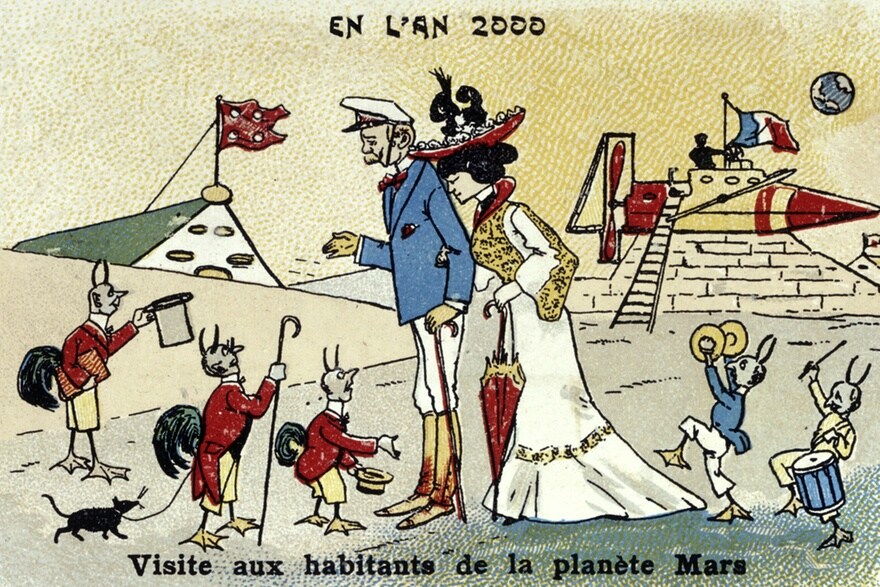
« En l’an 2000, visite aux habitants de la planète Mars ».
Carte postale publicitaire pour Campari, 1906.
Source : swissinfo.ch.

Or n’avait tout le monde qu’un langage et une façon de parler. (…) Dont le Seigneur descendit pour voir la ville et la tour que les hommes bâtissaient. Car il disait : Voici un peuple qui n’est qu’un, et n’ont tous qu’un langage, et osent bien faire telle chose ; il n’y aura rien qu’ils entreprennent de quoi ils ne viennent à bout. Il nous faut descendre et brouiller leur langage, de sorte qu’il n’entendent point le parler de l’un de l’autre. — Genèse XI:1-7, trad. Sébastien Castellion (1555).

Comment un martien, à la descente de sa fusée, ne resterait-il pas médusé devant le babil incompréhensible qui constitue la rumeur du monde ? Arrivé à Roissy, il s’entend dire par le douanier :

— Avez-vous vos papiers ?

Grâce à son traducteur automatique universel et électronique, il comprend tout de suite de quoi il s’agit, et il tend au gabelou sa carte d’identité interstellaire. Une fois sorti de l’aérogare, il se voit interpellé par le chauffeur en uniforme d’une voiture de maître, qui lui demande :

— Monsieur veut-il aller à Paris ?

Bien que son dictionnaire lui offre plusieurs explications incompréhensiblement inconciliables (paris mutuels ? Paris des lumières ? Paris Texas ?), il s’y engouffre, et demande au conducteur de l’amener dans le quartier le plus typique de la ville.

Et c’est ainsi que, deux heures plus tard et délesté des quelques milliers d’euros que la course lui a coûté, il se retrouve rue Saint Denis. Une jeune rousse à la couleur peu naturelle et à la voix gouailleuse l’aborde poliment :

— Tu viens chez moi, chéri ?

tandis qu’une noire sculpturale à l’accent fortement québécois (c’est son dictionnaire qui le lui signale discrètement) le sollicite ainsi :

— Tu viens-t’y chez nous que j’m’occupe de tes gosses ?

Il équarquille ses trois grands yeux : il a laissé ses enfants à la maison, et la blonde (puisque c’est ainsi qu’on appelle les noires affectueuses dans la Belle province) est pourtant seule aussi, alors pourquoi ce « nous » ? Lui propose-t-elle déjà le mariage et le partage de ses biens (immobiliers) ?

Dérouté par la grammaire autant que par les comportements de cet étrange pays, il repart aussitôt, après avoir toutefois poliment remercié ces dames pour leur hospitalité.

Il passe brièvement à Londres, où tout le monde se vouvoie sauf quand l’interlocuteur a une taille très élevée (c’est ainsi qu’il comprend le “Your Highness”) : on lui parle à la troisième personne du singulier (tout en utilisant la deuxième personne du pluriel, “Does your Lordship mean, when you say, ‘the real essence of a man, and an horse, and a tree,’ but that there are such kinds, already set out, by the signification of these names, man horse, tree?”), ou alors lorsqu’un Britannique s’adresse à Dieu : il le tutoie avec une familiarité déconcertante, tandis que leur souverain terrestre parle de lui-même à la première personne du pluriel.

Parti se reposer aux Baléares, il constate que son séjour n’y sera finalement pas de tout repos : entre le , Usted et Vosotros il ne sait plus où donner de ses deux têtes, et s’aperçoit, lors d’un bref passage en Amérique latine, qu’il n’avait pas encore rencontré les Vos et Ustedes.

À Jérusalem, tout paraît simple : en hébreu il n’y a que le tutoiement. Mais petit hic, le pronom n’est pas le même selon qu’il s’adresse à un homme ou à une femme, et avec les tenues très unisex d’une part, le machisme des femmes et la langueur de certains hommes d’autre part, il est sûr de se tromper à tous les coups. Et quand il apprend que l’un des noms donnés à leur seul et unique Dieu est un mot pluriel (ce qui est, avoue-t-il, très singulier), il se dit qu’il est temps de repartir vers sa famille qui lui manque terriblement et avec lesquels il ne communique que par gestes, ce qui évite tous ces problèmes que les terriens se créent inutilement.

30 octobre 2010

On bringing Europe’s cultural heritage online

Classé dans : Actualité, Littérature, Livre, Musique, Sciences, techniques — Miklos @ 5:01

This text is an expanded version of a position paper and an oral statement to the Comité des Sages at their public hearing on 27 November 2010.

Introduction

The younger generations listen to music all the time, yet, as Jill Cousins has pointed out in her statement to the Comité des Sages, only 2% of Europeana is musical contents. This has got to change.

I live in a black hole, that of an archive of unpublished recordings of live performances of contemporary art music: this raises specific barriers in identifying and obtaining the rights to digitize and make available these documents on the Web on our own sites and all the more so to communicate them to Europeana.

I also live in a no-man’s-land squeezed out from the public-private dichotomy, namely that of the not-for-profit private organizations: they don’t benefit from full government financial support1 on the one hand, and can’t develop commercial or marketing strategies on the other hand. This limits their capacity to raise adequate funds to digitize their collections.

One of my tasks at IRCAM has been to design and operate the Portal of contemporary music resources in France, a project which has been partially financed by the French Ministry of Culture. It is a partnership of more than thirty providers – archives, libraries, museums, conservatories, music ensembles, centers for contemporary music… -, all but a couple of which are not-for-profit organizations, all with interesting and sometime unique music archives2 of contemporary works but most without librarians, archivists or specialists of computers and digitization. Most are small – in size and in budget – and appreciate the added visibility such a portal provides to their heritage, and don’t see it as a threat.

This Portal aggregates all the information about their holdings and the events they organize, whether or not that information points to actually digitized documents: this allows localizing relevant resources, such as books, periodicals, music scores and archival documents, which might never be digitized in a foreseeable future. We believe that cultural heritage is not only digital cultural heritage, echoing the concern voiced earlier today by Lucie Verachten from the Belgian Archives, and so “bringing it online” must include also bringing online metadata with no associated data.

This is not what Europeana does (unfortunately, in my opinion). As a consequence, this Portal, which is harvested by Europeana, provides it only with those records pointing to digital resources made available by our partners. Yet, we can’t let Europeana access our audio digital items, nor even just provide thumbnails for them.

How come? The exceptions to the 2001 Directive on the harmonisation of certain aspects of copyright and related rights in the information society3 and the Commission’s recommendation of 24 August 2006 on the digitisation and online accessibility of cultural material and digital preservation4 do not go far enough in addressing some aspects more specifically related to networked digital libraries, to archived musical material and to the kind of cultural institutions that can benefit from exceptions.

I’ll briefly address three implications of this problem, which creates barriers to bringing Europe’s cultural heritage online.

1. Copying for the purpose of indexing and semantic enrichment.

Contrarily to other major digital libraries such as Gallica, Hathi Trust, the Gutenberg project, Scribd or Google Books, Europeana cannot provide full-text search into the many digitized books which it references, but only in its metadata.

Why this limitation? Europeana, as a networked library, does not contain (in its computers) these documents while these digital libraries do. The current laws and their exceptions do not automatically entitle Europeana to make a copy of them from their holders, its content providers and aggregagors, although these documents are already made available either publicly on their web sites or on dedicated terminals on their premises.

This is a very serious disadvantage, as it means that Europeana is, in effect, not more than a large catalogue (of digital objects for sure), but not a full-fledged digital library. Were it able to access the contents, it could not only provide that missing important search feature, but also semantically enrich the collection in many innovative ways arising from the analysis of the contents rather than just of its metadata.

One could envision a more generous exception that would allow Europeana and similar cultural digital libraries – in public institutions and not-for-profit private organizations (which are not mentioned in the exception, see note 5) – to make a temporary copy of the documents5 – even copyright-protected documents – so as to allow for their full indexation and meaningful semantic enrichment: as a result, a search for a phrase (say) would return the lists of the books in which this sentence can be found, and allow the public to access these books on their provider’s sites if publicly accessible (partially or totally) or just identify where in the books the search phrase can be found (as Google Books does for books under copyright).

Such an exception should also cover non-textual material, i.e., sound and audiovisual cultural material (contrarily to the opinion of one of the earlier speakers today). Many techniques of information retrieval are already applicable to musical (and other audio) contents.

2. Rights clearance for musical sound archives

Several speakers, and in particular Renate Dörr from the ZDF, have already addressed some of the especially difficult aspects of clearing the rights needed to digitize and make available musical sound recordings. In her subsequent statement, the representative of the AEPO, Guenaëlle Collet, asserted that this was always feasible, and that the rights collecting societies had the knowledge and resources to help doing so. This is probably true (to some extent at least) for commercial recordings, yet is far from being so for unpublished, archived contents.

In order to be able to digitize their own sound archives and make them available on “dedicated terminals on their premises”, our content providers have to go through a sometime endless and impossible process of identification of all rights holders, all the more difficult when it concerns large archives and when the holders – small cultural organizations such as musical ensembles – do not have, and never had, archivists or librarians who would have thought of, and known how to, keep exceedingly detailed records: they don’t have a publisher to turn to, and have to do the work themselves.

Consider, e.g., a recording of a live concert of 30 years ago that they performed or produced: they would have to identify not only the works and the composers (that’s usually not a problem), but also all the soloists and performing musicians which sang or played on that date in the orchestra or sang in the choir, the publishers of the scores that were used then (it is sometimes impossible to determine as well: some premières might have been played from manuscript scores before their subsequent publication) and if the published score had been bought or rented for that performance…

This in effect prevents them clearing up the rights fully, and is one of the two principal causes for the scarcity of digitized sound heritage, the other one being the high digitization costs, which small institutions can’t afford, all the more so when they are not-for-profit private ones (whence the pressing need for increased public support, as Ben White from the British Library already mentioned).

My recommendation would be to address this barrier by e.g. extending the principle of, and dispositions for, orphan works to sound and audiovisual material6 (to echo Ben White again), or, alternatively, to allow for collection-level rights management (rather than on an individual-archive basis) or even global licences in such cases.

3. Music thumbnails

When one launches a search in Europeana, the results pages show, for each found item, a thumbnail with a descriptive, textual subtitle. This is at least true of text (typically: a small image of a page), of a still image (a reduced view of it or of part of it) and of video (a frame). But in the case of music, there is no general method or algorithm to produce a visual display, all the more so for a sound archive without any accompanying printed documentation7.

Yet it is technically feasible to produce automatically a sound excerpt, and to embed a player (displayed as a play button) of any size – in this case the size of the vignettes used by Europeana – in the results pages. By clicking on this player, the user would be able to listen to this excerpt. This could significantly enhance the search and discovery experience in Europeana by making digital sound recordings “equal citizens” to the other Europeana assets.

Yet while it is possible to provide free citations or thumbnails of text (and arguably of still images), it is definitely not the case for recorded music (as well as for printed music scores). In order to allow the users of our Portal to listen to such excerpts and get an idea of what the music sounds like (and looks like, for music scores), our providers have to pay an extra fee8 to the various rights collecting societies (authors, performers…), which they do.

But this does not allow them to make use of this excerpt on any other web site than their library’s and the Portal: even just in order to use an excerpt on another of their web site, they would have to pay an additional fee. As a result, they can’t allow Europeana to include this excerpt either in the results page or in the record page. So in addition to the scarcity of musical contents referenced by Europeana (see point 2 above), that which is there is not adequately “displayed”.

I would recommend addressing this barrier by e.g. extending the public interest exception for cultural non-commercial purposes to allow for free limited citations of musical (and audiovisual) works as it is the case for text (or at least for the free non-commercial reuse of such citations for which rights have been cleared for their first use). This would not be detrimental in any way to the composers and the performers. On the contrary, such excerpts act as promotional material, as the many messages to the Portal show: people who have listened to them ask where they can listen to the full work, where they can buy a commercial recording thereof or where they can buy or rent the score in order to perform the work.

Thank you.


1 The French Plan national de numérisation grants 100% of the budget of digitization projects to public institutions, but only up to 50% to private not-for-profit organizations.

2  Sound recordings, but also music scores, program notes, etc.

3  Related to preservation purposes, for the benefit of people with a disability and for research and private study on the premises.

4  To improve conditions for digitisation of, and online accessibility to, cultural material by” addressing the issue of orphan works, and “make provision in their legislation so as to allow multiple copying and migration of digital cultural material by public institutions for preservation purposes.

5 I had suggested such a mechanism in a 2005 letter to the then President of the French National Library, Jean-Noël Jeanneney (available here), in which I was outlining how such a networked digital library could be designed.

6 Fees would still be paid to rights collecting societies, and the monies would be put in escrow.

7 In the case of a commercial CD, the cover of the booklet may be displayed, e.g.

8 I.e., in addition to what they have already paid in order to digitize the sound archive and provide full access to in on dedicated terminals on site only.

30 septembre 2010

Une nouvelle salle de concert à Paris

Classé dans : Actualité, Architecture, Musique, Photographie — Miklos @ 19:21

« Plus de deux mille personnes assistaient avant-hier à l’ouverture de la nouvelle salle de concert, construite pour M. Musard et ses exercices musicaux. Placée à l’extrémité de la rue Vivienne, près du boulevart, cette salle joint à l’avantage de sa position l’élégance de ses ornemens, l’éclat de ses peintures; c’est un palais de fées, dont la musique est le principal enchantement. Ouvertures, morceaux dramatiques, quadrilles, solos, concertantes, galops, tel est le brillant répertoire que M. Musard a fait exécuter par son orchestre habile et nombreux. Doit-on moins apprécier toutes ces merveilles en apprenant que l’on en peut jouir chaque soir pour vingt sous ? » — Revue de Paris, 1836.

Les débats à propos du besoin d’une nouvelle salle de concert à Paris ne datent pas d’hier, et les grandes manœuvres annoncées en 2006 sont loin d’être achevées, c’est le moins qu’on puisse dire : le studio 104 de Radio France (à ne pas confondre avec le CENTQUATRE, qui, de son côté, « peinait à trouver son public et son souffle », selon Télérama), plus connu sous le nom de salle Olivier Messiaen, voit sa fin annoncée, tandis qu’un nouvel auditorium, destiné à remplacer les studios 102 et 103, est en cours de construction.

De son côté, le chantier de la Philharmonie, à la Cité de la musique, est en panne, selon le Parisien (si c’est du fait de l’État, les deux autres partenaires ne devraient pas être si mécontents, in petto, de ne pas avoir à verser leur obole, en ces temps de crise).

La salle Pleyel, elle, a bien rouvert en 2006 et propose une foison de concerts où chacun pourra y trouver son compte, du classique au jazz, au rock et électro, à la chanson et aux musiques du monde. Après de rocambolesques aventures, elle est devenue la propriété de la Cité de la musique en juin 2009. Le Parisien qui rapporte ces événements clôt son article par une phrase quelque peu sibylline.

Et puisque l’on parle chantiers musicaux, celui de la Gaîté lyrique (qui a échappé à un sort autrement gay) devrait finalement s’achever d’ici au printemps 2011, selon le Figaro (qui annonçait en 2008 la fin du chantier pour novembre 2009).

Amateurs de musique, ne désespérez pas : une nouvelle salle vient de s’ouvrir à coût zéro devant le centre Pompidou. Comme on peut le constater ci-dessous, s’y sont donnés récemment deux récitals de piano. Gratuits, même pas les vingt sous qu’on payait à la nouvelle salle de la rue Vivienne. Les concerts y sont tout aussi variés que dans les autres lieux : piano, mais aussi violon, flûte, cuivres, didjeridoo, percussions et électronique (hyper)amplifiées, solistes, groupes, danseurs, acrobates… Une vraie cour des miracles musicaux !


28 septembre 2010

Une vision british irish des vols à bas coûts

Classé dans : Cinéma, vidéo, Humour, Langue, Musique — Miklos @ 23:55

Prendre l’avion était une aventure et un luxe que seuls les nantis pouvaient s’offrir ; il en allait aussi d’ailleurs du saumon fumé, des robes de grands couturiers ou des meubles de design. Puis apparurent les low-cost (dans les années 1970), les grandes surfaces, le prêt-à-porter et Ikea : tout le monde peut dorénavant paraître aussi bien transporté, nourri, habillé et logé que ceux qui illustrent les pages glacées des magazines qui font rêver (et vendre). Mais y gagne-t-on vraiment, tous comptes faits ?

Fascinating Aïda est un trio de chansonnières very English : humour décalé, dent aiguisée, langue épicée, le tout interprété avec une classe digne de Buckingham. Jugez-en : dans leur récent spectacle, les trois gentilles sorcières dont la solide formation musicale classique est mise à profit d’une façon qui ne décevrait pas les grands de l’opérette qu’étaient Gilbert et Sullivan (les Offenbach anglais) s’en prennent aux vols dégriffés : ceux-ci, comme on l’a tous sans doute vécu, s’avèrent parfois être un gouffre financier pour les gogos qui, par la pub alléchés, leur tendent leur carte de crédit (en d’autres mots, ils méritent bien leurs dénominations de « vol » et de « coups bas »). Quant à partir et arriver à l’heure, voire à la bonne destination (non, pas au Paradis, pas encore), c’est un coup de poker souvent menteur.

Le texte (retranscrit sous la vidéo), émaillé d’expressions (très) couleur locale collant parfaitement au rythme endiablé de la musique façon irlandaise (la soliste, Dillie Keane, est originaire de Dublin et son accent en témoigne joliment), est intra­duisible sans en altérer la saveur ou le surcharger d’explications oiseuses, on se contentera d’en donner l’idée générale.

We received an invitation in the post one Monday morn’
To attend our cousins wedding in the town where we were born
The do was back in Kerry; so wishing to be frugal
We trawled the ‘net to find some decent travel deals on Google

Un lundi matin, nous reçumes par la poste une invitation au mariage de nos cousins dans notre ville natale du Kerry.
 
Voulant économiser, nous décidâmes d’écumer le net afin de trouver sur Google un vol à prix raisonnable.

Cheap flights, cheap flights, cheap as they can be,
Bedad we found an airline selling flights for 50p,
(Diddly aiden daidin daidin dai)

Ah, ces vols bon marché…
 
Par Dieu ! on a trouvé une compagnie qui vend des vols pour 50 pence (0,58 €).

Well we clicked on to the website and were mightily surprised,
To find the actual cost wasn’t quite as advertised,
We’d forgotten airport taxes, that also’d to be billed,
But a bargain is a bargain and begorrah we were thrilled,

En cliquant sur son site, nous avons été ahuries de constater que le coût réel n’était pas tel qu’annoncé.
 
Nous avions oublié les taxes d’aéroport, mais une bonne affaire c’est une bonne affaire, et crénom ! on était toutes excitées.

Cheap flights, cheap flights, Stanstead to Tralee,
It isn’t every airline offers flights for 50p,
(Diddly aiden daidin daidin dai (x3))

Ah, ces vols bon marché…
De Stanstead à Tralee*, on ne trouve pas de vols à 50 pence chez la plupart des compagnies.

After studying the website we decided it was best,
To pay priority boarding so that we’d sit three abreast,
(Three abreast, that’s the best)
And of course we’d all have luggage, so that’s an extra cost,
And then we paid insurance in case our cases might get lost,

Après avoir consulté attentivement le site, on se décide à payer pour l’embarquement prioritaire qui nous permettrait d’être assises toutes les trois ensemble.
 
En plus, comme on avait toutes des bagages, il y avait un surcoût.
Et en plus on a payé l’assurance en cas de perte de nos valises.

Our cheap flights, cheap flights, it’s obvious to see,
There must be extra charges when the flights are 50p,
(Minya, minya, minya, key change)

Ah, ces vols bon marché…
C’est évident qu’il doit y avoir un surcoût si leur prix est 50 pence.
(minya, minya, minya, modulation)

At last the flight was booked, with all of the additions,
We’d read the realms of medium print, of terms and conditions,
And then picked up the charge for using VISA which was drastic,
‘Cause how the feck are you supposed to pay if not with fecking plastic?

Finalement on a réservé le vol avec tous les extras, on a lu toutes les mentions et conditions écrites en tout petit, et payé les frais supplémentaires assez salés pour l’utilisation d’une carte Visa.
Mais putain ! comment peut-on payer autrement qu’avec une putain de carte?

Cheap flights, cheap flights, we paid the fecking fee,
Because by now we were committed to the flights for 50p,
(Diddly aiden daidin daidin dai (x3))
(Someone’s being diddled and it’s us, so it is)
(a-hmm, a-hmm, a-a-a-a-a-a-a-a-hmm)

Ah, ces vols bon marché… On a payé les putains de frais puisqu’on s’était engage à prendre ce vol à 50 pence. Si quelqu’un s’est fait eu, c’est nous.

Now I don’t know if you’ve tried looking at Stanstead on a map,
But checking in at 5am is a fecking load of crap,
It’s packed if you try to catch a train or underground,
So a taxi to the arse in the world was more than 100 pounds,

Je ne sais pas si vous avez jamais cherché Stanstead sur une carte, mais s’embarquer là-bas à 5 heures du matin c’est vraiment merdique. Si on essaie de prendre un train ou le métro, ils sont bondés. Le taxi que nous prîmes pour ce trou du cul du monde nous a coûté plus que 100 £ (116 €).

Cheap flights, cheap flights, we should have gone by sea,
There’s no such fecking thing as a fecking flight for 50p,
(Feckity feckity feckity feckity feck, feck, feck (x2))

Ah, ces vols bon marché… On aurait dû partir en bateau. Les putains de vols à ces putains de 50 pence ça n’existe pas.
(Fuck, fuck, fuck…)

Then at last we reached the airport where we had to pay a fine,
The fecking feckers charged us ’cause we hadn’t checked in online,
And finally aboard the flight there’s an extra class of tax,
‘Cause the fecking fecking feckers fecking charge to use the jacks,

On arrive finalement à l’aéroport où l’on a dû payer une amende, ces putains de mecs nous l’ont imposée parce qu’on ne s’était pas enregistrées en ligne. Et à bord, une putain de putain de taxe de plus pour utiliser les toilettes*.

Cheap flights, cheap flights, I think you must agree,
That only fecking gobshites think there’s flights for 50p,
(Feck, shite, feck, shite, feck, shite, arse)
(Feck, shite, shite, feck, feck, shite, arse)

Ah, ces vols bon marché… Vous êtes d’accord qu’il n’y a que des putains de gogos qui croient qu’il y a des vols à 50 pence.
(Fuck, merde, cul)

Sad verse
Well finally we landed and tried to shuffle up the aisle
But the steward sent us down to the back with never a hint of a smile
And as we heard his annoucement our hearts gave a terrible thump
If you havent prepaid to use the steps you’ll have to feckin jump

Couplet triste.
On a finalement atterri, et on essaie d’avancer vers l’avant, mais le steward, sans l’ombre d’un sourire, nous renvoie vers l’arrière, et on a eu un choc terrible au cœur (boum !) quand on a entendu son annonce, comme quoi si on n’avait pas prépayé pour utiliser l’escalier, il fallait sauter.

Cheap flights, cheap flights you’re harking on to me
you’re an idiot if you think a fecking flight is 50p
Feck!

Ah, ces vols bon marché… écoutez-moi bien : vous êtes un sacré con si vous croyez qu’un putain de vol coûte 50 pence. Merde !

* On ne sera pas si étonné que ça d’apprendre quel est l’opérateur du vol Stansted-Tralee (si connu pour les surprises qui émaillent ses tarifs et ses vols, et qui annon­çait vouloir faire voyager ses passagers debout et faire payer pour l’uti­li­sa­tion de ses toilettes), ni le nom du site où se trouve cette information :

(Vidéo et paroles reproduites avec autorisation)

The Blog of Miklos • Le blog de Miklos