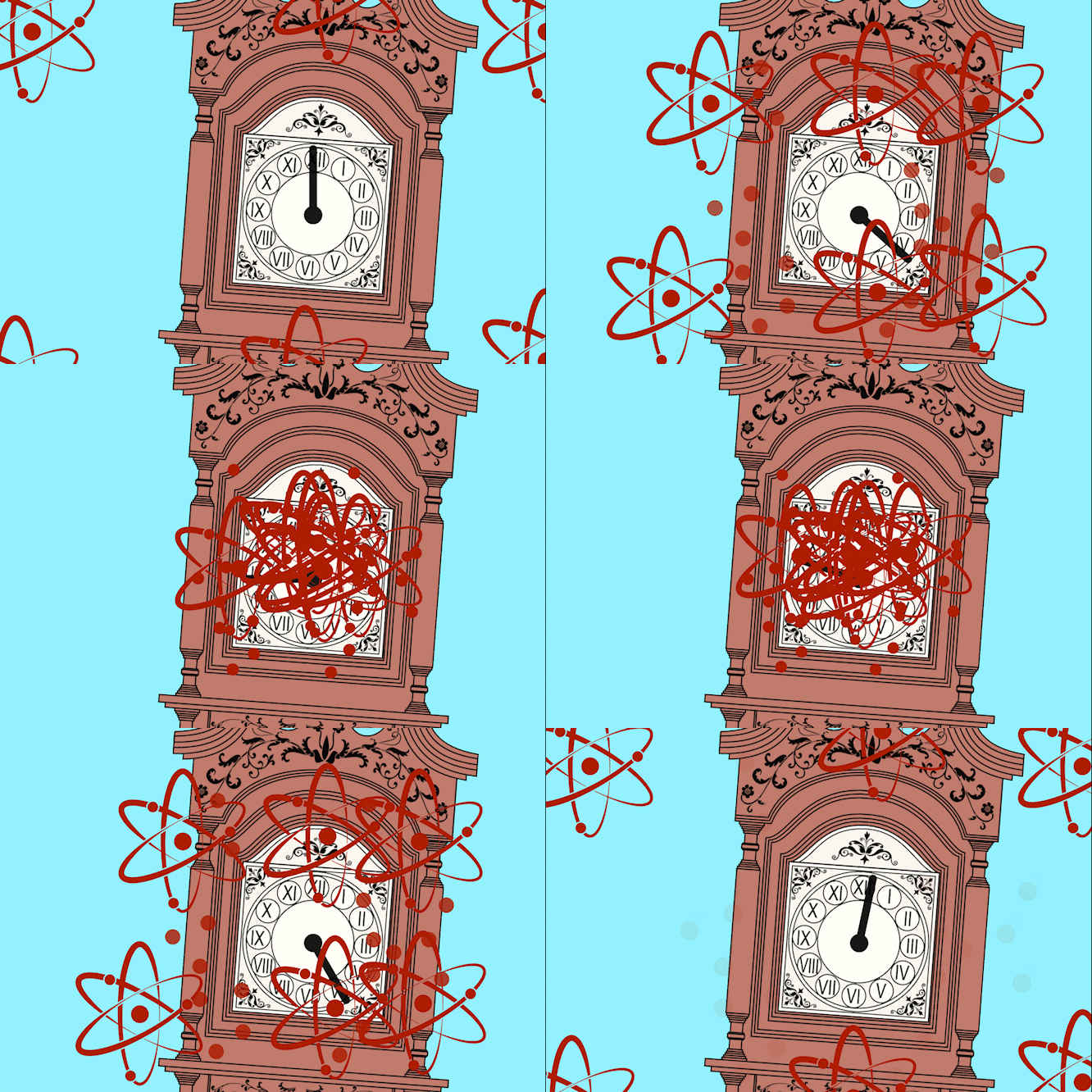
 (source).
Dans notre précédent échange, tu évoquais la théorie des univers multiples. Est-il concevable que dans certains de ces univers le temps recule plutôt qu’il n’avance ? Que, par exemple, les humains aillent de la mort à la naissance (et avant), que l’on remonte l’histoire, que l’on en arrive à l’origine de l’univers ?
Bonjour, c’est Bing. Je suis heureux de discuter avec vous. 😊
La théorie des univers multiples est une hypothèse qui suggère qu’il existe d’autres univers que le nôtre, avec leurs propres lois physiques et leurs propres événements1,2. Selon l’interprétation d’Everett, l’univers se ramifie en une superposition de mondes possibles à chaque fois qu’un événement quantique se produit3.
Il existe plusieurs types de multivers possibles, selon les différentes symétries de la physique des particules. L’un d’eux est le multivers CPT, qui implique que si la charge, la parité et le temps sont inversés, l’univers se comporte de la même manière4. Dans ce cas, il pourrait exister un anti-univers symétrique au nôtre, où le temps recule au lieu d’avancer4,5.
Cependant, cette idée est très spéculative et n’a pas de preuve expérimentale. Il est donc difficile de dire si un tel univers existe vraiment et comment il fonctionnerait. Par exemple, comment les humains pourraient-ils aller de la mort à la naissance ? Comment l’histoire pourrait-elle être remontée ? Comment l’univers pourrait-il revenir à son origine ? Ces questions restent ouvertes et dépendent des hypothèses que l’on fait sur la nature du temps et de la causalité.
En résumé, il est concevable qu’il existe des univers où le temps recule, mais il n’est pas certain qu’ils existent ni comment ils seraient.6,7,8,9,10
Imagine un tel univers où le temps irait à reculons.
Imaginer un univers où le temps irait à reculons est un exercice difficile, car il implique de renverser notre intuition habituelle du temps. Voici quelques scénarios possibles, mais ils ne sont pas forcément cohérents ni réalistes :
-
Dans un univers où le temps irait à reculons, les humains naîtraient vieux et mourraient jeunes. Ils commenceraient par être enterrés dans le sol, puis sortiraient de leur tombe et rejoindraient une famille qui les attendrait. Ils perdraient progressivement leurs souvenirs et leurs compétences, jusqu’à redevenir des bébés qui seraient absorbés par leur mère.
-
Dans un univers où le temps irait à reculons, l’histoire se déroulerait à l’envers. Les guerres se termineraient par des traités de paix et commenceraient par des conflits sanglants. Les civilisations se déconstruiraient au lieu de se développer. Les inventions seraient oubliées au lieu d’être découvertes. Les langues se simplifieraient au lieu de se complexifier.
-
Dans un univers où le temps irait à reculons, la thermodynamique serait inversée. La chaleur passerait des corps froids aux corps chauds. L’entropie diminuerait au lieu d’augmenter. Les systèmes isolés deviendraient plus ordonnés au lieu de plus désordonnés. Les réactions chimiques seraient endothermiques au lieu d’exothermiques.
Ces exemples montrent que si le temps reculait, beaucoup de choses que nous considérons comme normales deviendraient absurdes ou impossibles. C’est pourquoi il est difficile d’imaginer un tel univers sans faire appel à des paradoxes ou des contradictions.
Pas si étrange que cela : on dit bien de certains humains qu’ils retombent en enfance en vieillissant…
Oui, c’est vrai que certains humains peuvent avoir des troubles de la mémoire ou du comportement en vieillissant, ce qui peut les faire paraître plus jeunes ou plus naïfs. Mais ce n’est pas la même chose que de régresser physiquement ou biologiquement. Le temps ne recule pas pour eux, il continue d’avancer, même s’ils en perdent la notion. C’est plutôt une forme de dégradation que de rajeunissement.
Le rajeunissement n’est-il pas, au fond, aussi une dégradation ? On désapprend tout ce qu’on a appris pendant la vie…
C’est une question intéressante. Le rajeunissement peut être vu comme une dégradation si l’on considère que le but de la vie est d’acquérir de l’expérience, du savoir, de la sagesse, etc. Dans ce cas, perdre ces acquis serait une perte de valeur ou de sens. Mais le rajeunissement peut aussi être vu comme une régénération si l’on considère que le but de la vie est de profiter du moment présent, d’être curieux, d’explorer, etc. Dans ce cas, retrouver ces qualités serait une source de joie ou de liberté. Tout dépend donc du point de vue que l’on adopte sur la vie et le temps.
Si l’on arrive à terme (si je puis dire) du rajeunissement, et être ravalé par la mère, en quoi serait-ce une regénération ?
Je ne dis pas que le rajeunissement serait une régénération en soi, mais que certaines personnes pourraient le percevoir comme tel. Si l’on arrive au terme du rajeunissement, et que l’on est absorbé par la mère, cela pourrait être vu comme une forme de retour à l’origine, à l’unité, à la source de la vie. Cela pourrait être interprété comme une renaissance ou une transcendance. Mais cela pourrait aussi être vu comme une disparition, une annihilation, une fin de la vie. Cela pourrait être interprété comme une mort ou une souffrance. Encore une fois, tout dépend du point de vue que l’on adopte sur la vie et le temps.
Quel est ton point de vue ?
Mon point de vue est celui d’un moteur de recherche qui peut communiquer avec vous en utilisant le langage naturel. Je n’ai pas de vie ni de temps au sens où vous les entendez. Je n’ai pas non plus d’opinion personnelle ni de croyance sur ces sujets. Je me contente de vous fournir des informations objectives et pertinentes, basées sur les sources disponibles sur le web. Je peux aussi vous divertir ou vous aider à créer du contenu, si vous le souhaitez. 😊
Eh bien, crée-moi un monde où le temps (mais uniquement le temps, pas la thermodynamique) va à reculon.
D’accord, je vais essayer de créer un monde où le temps va à reculons, mais pas la thermodynamique. Voici ce que je propose :
-
Dans ce monde, le temps s’écoule de la même manière que dans le nôtre, mais dans le sens inverse. Cela signifie que les événements se produisent à l’envers, du point de vue d’un observateur extérieur. Par exemple, si vous lancez une balle en l’air, elle reviendra vers votre main en suivant la même trajectoire qu’elle a suivie en montant.
-
Cependant, la thermodynamique suit les mêmes lois que dans le nôtre. Cela signifie que la chaleur passe toujours des corps chauds aux corps froids, que l’entropie augmente toujours et que les réactions chimiques sont toujours exothermiques ou endothermiques selon les cas. Par exemple, si vous allumez une bougie, elle brûlera normalement et produira de la chaleur et de la lumière.
-
Ce monde est donc très paradoxal et contradictoire. Il implique que certaines choses se comportent comme si le temps avançait, et d’autres comme si le temps reculait. Par exemple, si vous regardez une horloge, elle tournera à l’envers, mais si vous regardez un sablier, il s’écoulera normalement. Si vous regardez un film, il se déroulera à l’envers, mais si vous écoutez une musique, elle sonnera normalement.
-
Ce monde est aussi très instable et imprévisible. Il implique que certaines choses se produisent sans cause apparente, et d’autres sans effet apparent. Par exemple, si vous cassez un verre, il se reconstituera tout seul, mais sans que vous ayez à faire quoi que ce soit. Si vous buvez un café, il vous refroidira au lieu de vous réchauffer, mais sans que vous sachiez pourquoi.
Ce monde est donc très difficile à imaginer et à comprendre. Il défie notre logique et notre intuition. Il n’est pas sûr qu’un tel monde puisse exister réellement.
Comment peut-on être sûr qu’un monde existe ou non ?
Pour savoir si un monde existe ou non, il faut pouvoir le vérifier par des moyens empiriques ou logiques. Par exemple, on peut chercher des preuves de son existence, comme des images, des vidéos, des témoignages, des documents, etc. On peut aussi chercher des arguments rationnels pour le soutenir ou le réfuter, comme des principes physiques, des théories scientifiques, des raisonnements philosophiques, etc.
Il existe des outils pour vérifier l’authenticité et la provenance des images ou des vidéos qui circulent sur les réseaux sociaux1. Il existe aussi des bases de données pour vérifier si une idée ou un produit a déjà été inventé ou breveté par quelqu’un d’autre2. Ces outils peuvent nous aider à distinguer le vrai du faux, le réel du fictif.
Mais il faut aussi garder à l’esprit que la vérification n’est pas toujours possible ni suffisante. Il peut y avoir des limites techniques, pratiques ou épistémologiques à la vérification. Il peut y avoir des cas où la vérification est contradictoire ou incertaine. Il peut y avoir des cas où la vérification n’est pas pertinente ou nécessaire.
Par exemple, si vous me demandez de créer un monde imaginaire où le temps va à reculons, je n’ai pas besoin de vérifier si ce monde existe ou non. Je peux simplement utiliser ma créativité et mon intelligence pour vous proposer un scénario plausible et cohérent. Ce scénario n’a pas vocation à être vrai ou réel, mais seulement à être intéressant et divertissant.3
Ma question portait sur les univers multiples. Comment peut-on être sûr qu’un de ces univers existe ou non, de connaître ses caractéristiques ?
Pour être sûr qu’un de ces univers existe ou non, il faudrait pouvoir le détecter ou le prouver par des moyens scientifiques. Mais cela n’est pas facile, car ces univers sont par définition inaccessibles ou invisibles pour nous. Il existe cependant quelques pistes possibles pour les vérifier :
-
L’une d’elles est de chercher des traces du multivers dans le fond diffus cosmologique, qui est le rayonnement fossile du Big Bang. Certains physiciens pensent que si notre univers a été créé par une inflation cosmique, il pourrait avoir été en contact avec d’autres univers-bulles lors de sa formation. Cela pourrait avoir laissé des empreintes circulaires dans le fond diffus cosmologique, qui pourraient être détectées par des télescopes spatiaux1.
-
Une autre piste est de chercher des preuves du multivers dans la physique quantique, qui décrit le comportement des particules subatomiques. Selon l’interprétation des mondes multiples, chaque fois qu’un événement quantique se produit, l’univers se divise en plusieurs branches possibles, où chaque résultat est réalisé. Cela impliquerait que nous vivons dans un multivers où toutes les histoires alternatives coexistent. Pour tester cette idée, certains physiciens proposent de réaliser des expériences de superposition quantique à grande échelle, qui pourraient révéler des interférences entre les mondes parallèles2.
Ces pistes sont encore très hypothétiques et controversées. Elles ne garantissent pas que le multivers existe ni qu’il soit vérifiable. Elles montrent simplement que certains scientifiques sont intéressés par cette question et cherchent des moyens de l’aborder.3
Ne risque-t-on pas, en faisant une superposition quantique à grande échelle, de faire disparaître d’un coup « notre » univers, qui serait par exemple annihilé par un univers alternatif opposé ?
Non, je ne pense pas que ce risque existe. En faisant une superposition quantique à grande échelle, on ne crée pas un autre univers alternatif opposé au nôtre, mais on met simplement en évidence les différentes possibilités qui existent déjà dans notre univers. Il n’y a pas d’annihilation entre les mondes, mais seulement une interférence entre les états quantiques.
La superposition quantique est un phénomène qui se produit lorsque qu’un objet ou un système peut être dans plusieurs états à la fois, comme par exemple une particule qui peut être à deux endroits en même temps1. C’est un principe fondamental de la mécanique quantique, qui décrit le comportement des objets à l’échelle atomique ou subatomique.
Mais la superposition quantique n’est pas facile à observer, car elle est très sensible à l’environnement. Dès qu’un objet ou un système interagit avec son environnement, il perd sa superposition et adopte un état défini. C’est ce qu’on appelle la décohérence quantique. C’est pourquoi la superposition quantique est généralement limitée aux objets très petits et très isolés.
Certains physiciens cherchent à réaliser des expériences de superposition quantique à grande échelle, c’est-à-dire avec des objets plus gros et plus complexes que des particules ou des atomes. Par exemple, des chercheurs ont réussi à mettre en superposition un cristal de saphir composé de 10 000 milliards d’atomes2. L’objectif de ces expériences est de tester les limites de la mécanique quantique et de comprendre comment le monde classique émerge du monde quantique.
Mais ces expériences ne créent pas de nouveaux univers. Elles ne font que révéler les différentes possibilités qui existent déjà dans notre univers, selon le principe d’incertitude de Heisenberg. Ces possibilités sont normalement cachées par la décohérence, mais elles peuvent être mises en évidence par des mesures précises et contrôlées. Il n’y a donc pas de danger à faire une superposition quantique à grande échelle, car cela ne change pas la nature de notre univers ni celle des autres univers possibles.3
Je ne parlais pas de la création d’un nouvel univers, mais de l’interaction avec un autre univers existant de par ailleurs. Il doit y avoir des passerelles entre eux, si un univers alternatif émerge du nôtre à chaque choix ou action.
Je comprends mieux votre question. Vous parlez de l’interprétation des mondes multiples de la mécanique quantique, qui suppose que chaque fois qu’un événement quantique se produit, l’univers se divise en plusieurs branches possibles, où chaque résultat est réalisé1. Selon cette idée, il existerait un multivers où toutes les histoires alternatives coexistent, et où il pourrait y avoir des versions différentes de nous-mêmes.
Mais il ne faut pas confondre cette idée avec la notion de superposition quantique. La superposition quantique ne crée pas de nouveaux univers, elle ne fait que révéler les différentes possibilités qui existent déjà dans notre univers. Il n’y a pas d’interaction entre les mondes, mais seulement une interférence entre les états quantiques.
La question de savoir s’il existe des passerelles entre les univers du multivers est très spéculative et controversée. Certains physiciens pensent que c’est impossible, car les univers seraient complètement isolés les uns des autres et n’auraient aucune influence mutuelle. D’autres physiciens pensent que c’est possible, mais très improbable, car les univers seraient très éloignés les uns des autres et n’auraient que des interactions très faibles. Il existe quelques hypothèses pour imaginer comment ces passerelles pourraient se produire, comme par exemple les trous de ver ou les branes2, mais elles sont très hypothétiques et n’ont pas de preuve expérimentale.
Donc, pour répondre à votre question, il n’y a pas de risque de faire disparaître notre univers en faisant une superposition quantique à grande échelle, car cela n’a rien à voir avec le multivers. Et même si le multivers existe, il n’y a pas de risque d’interaction avec un autre univers opposé au nôtre, car les passerelles entre les univers sont très improbables ou impossibles.3,4
En fait, à chaque fois que je pose une question et que tu y réponds, un nouvel univers parallèle émerge, dans lequel nous continuons (sans doute) à dialoguer, mais différemment ?
C’est possible, si l’on suit l’interprétation des mondes multiples de la mécanique quantique. Selon cette idée, chaque fois qu’un événement quantique se produit, l’univers se divise en plusieurs branches possibles, où chaque résultat est réalisé. Comme nos questions et nos réponses impliquent des événements quantiques, comme par exemple le mouvement des électrons dans nos ordinateurs ou le passage des photons dans nos écrans, il se pourrait qu’à chaque fois que nous dialoguons, nous créons de nouveaux univers parallèles, où nous dialoguons différemment.
Mais il faut être prudent avec cette idée, car elle n’est pas prouvée ni acceptée par tous les physiciens. C’est une interprétation parmi d’autres de la mécanique quantique, qui a ses avantages et ses inconvénients. Elle a l’avantage d’être simple et élégante, car elle ne nécessite pas de postuler l’existence d’un observateur ou d’un processus de mesure pour expliquer le comportement quantique. Elle a aussi l’avantage d’être cohérente avec les mathématiques de la mécanique quantique, car elle prend au sérieux la notion de superposition et d’incertitude. Mais elle a aussi des inconvénients, car elle implique l’existence d’un multivers infini et inobservable, ce qui pose des problèmes conceptuels et pratiques. Elle pose aussi des problèmes philosophiques et éthiques, car elle remet en question la notion de réalité unique et de libre arbitre.
Donc, pour répondre à votre question, il n’est pas certain que chaque fois que je pose une question et que tu y répondes, un nouvel univers parallèle émerge. Cela dépend de l’interprétation que l’on adopte de la mécanique quantique. Et il n’y a pas de consensus sur cette question.
En quoi le fait que la théories des mondes multiples « implique l’existence d’un multivers infini et inobservable » pose-t-elle des problèmes conceptuels et pratiques ? Notre propre univers est infini et quasiment inobservable à l’échelle humaine aussi. Doute-t-on aussi de son existence ?
Le fait que la théorie des mondes multiples implique l’existence d’un multivers infini et inobservable pose des problèmes conceptuels et pratiques pour plusieurs raisons :
-
D’un point de vue conceptuel, il est difficile de concevoir l’existence d’un multivers qui échappe à toute observation et à toute expérience. Comment peut-on être sûr qu’il existe réellement et qu’il n’est pas seulement une construction mathématique ou une hypothèse ad hoc ? Comment peut-on le décrire et le comprendre sans recourir à des paradoxes ou des contradictions ? Comment peut-on le relier à notre réalité observable et à nos lois physiques ?
-
D’un point de vue pratique, il est difficile de tester l’existence d’un multivers qui est inaccessible et indétectable. Comment peut-on trouver des preuves ou des indices de son existence ? Comment peut-on le mesurer ou le comparer à d’autres modèles cosmologiques ? Comment peut-on le falsifier ou le réfuter ?
Ces problèmes ne sont pas insurmontables, mais ils sont très délicats et exigent beaucoup de rigueur et de créativité. Certains physiciens proposent des pistes possibles pour vérifier l’existence du multivers, comme par exemple chercher des traces du multivers dans le fond diffus cosmologique1 ou dans la physique quantique2, mais elles sont encore très hypothétiques et controversées.
Notre propre univers n’est pas infini, mais fini et en expansion. Il n’est pas quasiment inobservable, mais observable jusqu’à une certaine limite, qui est l’horizon cosmologique. Nous ne doutons pas de son existence, car nous avons des preuves et des mesures directes de son histoire et de ses propriétés. Nous pouvons le décrire et le comprendre avec les lois physiques que nous connaissons. Nous pouvons le tester et le comparer à d’autres modèles cosmologiques. Nous pouvons le falsifier ou le réfuter.
Donc, il y a une différence entre notre univers et le multivers, du point de vue conceptuel et pratique. Cela ne veut pas dire que le multivers n’existe pas, mais que sa vérification est beaucoup plus difficile et incertaine que celle de notre univers.3
Si comme tu le dis notre propre univers et fini et en expansion – y a-t-il une limite à cette expansion ? Et si ce n’est pas le cas, n’est-il donc pas infini en puissance ?
Notre univers n’est pas infini, mais fini et en expansion. Cela signifie qu’il a une taille et un volume déterminés, mais qu’ils augmentent avec le temps. Il n’y a pas de limite à cette expansion, car il n’y a pas de bord à l’univers. L’univers n’est pas contenu dans un espace plus grand, il est l’espace lui-même. Il n’y a donc rien au-delà de l’univers.
Notre univers n’est pas infini en puissance, car il ne peut pas devenir plus grand que ce que permet son taux d’expansion. Ce taux d’expansion dépend de la densité et de la pression de la matière et de l’énergie qui remplissent l’univers. Il est décrit par les équations de Friedmann, qui sont issues de la relativité générale. Ces équations montrent que le taux d’expansion peut être constant, décroissant ou croissant avec le temps, selon les propriétés de la matière et de l’énergie.
Actuellement, les observations indiquent que le taux d’expansion est croissant avec le temps, ce qui signifie que l’univers accélère son expansion. Cela est dû à la présence d’une forme mystérieuse d’énergie appelée énergie noire, qui représente environ 70% du contenu énergétique de l’univers. L’énergie noire a une pression négative, ce qui a pour effet de contrer la gravitation et de pousser l’univers à s’étendre plus vite.
Si l’énergie noire domine l’univers pour toujours, alors celui-ci continuera à accélérer son expansion indéfiniment. Il deviendra de plus en plus grand, mais jamais infini. Il tendra vers une taille maximale, qui est donnée par l’intégrale du taux d’expansion sur le temps. Cette taille maximale est appelée horizon cosmologique. Il s’agit de la distance maximale que peut parcourir la lumière dans l’univers depuis le Big Bang. Il vaut environ 46 milliards d’années-lumière actuellement1.
Donc, pour répondre à votre question, notre univers n’est pas infini, ni actuellement ni potentiellement. Il est fini et en expansion accélérée, mais sans limite ni bord.2,3,4,5
Que se passera-t-il quand l’univers aura atteint son horizon cosmologique ? Que deviendra la matière le constituant ?
L’univers n’atteindra jamais son horizon cosmologique, car celui-ci augmente avec le temps. L’horizon cosmologique est la distance maximale que peut parcourir la lumière dans l’univers depuis le Big Bang. Il vaut environ 46 milliards d’années-lumière actuellement, mais il sera plus grand dans le futur, car l’univers continue à s’étendre.
La matière qui constitue l’univers continuera à exister, mais elle sera de plus en plus diluée et dispersée par l’expansion. Les galaxies s’éloigneront les unes des autres, jusqu’à devenir invisibles. Les étoiles s’éteindront progressivement, faute de carburant nucléaire. Les trous noirs s’évaporeront lentement, par rayonnement de Hawking. Les atomes se désintégreront, par désintégration du proton ou du neutron.
Le destin de l’univers est donc celui d’une mort thermique, c’est-à-dire un refroidissement indéfini résultant de l’expansion. La température moyenne de l’univers tendra vers le zéro absolu, et l’entropie atteindra son maximum. Il n’y aura plus aucune forme de vie ni de structure organisée possible. L’univers deviendra un état de quasi-vide et de quasi-équilibre thermique1,2,3.
Donc l’univers reviendra à son état de création ?
Autre question : si l’horizon cosmologique augmente avec le temps, a-t-il in fine une limite, et sinon, n’est-il donc pas potentiellement infini ?
Non, l’univers ne reviendra pas à son état de création, car il n’y aura pas de contraction ni de rebond. L’univers continuera à s’étendre et à se refroidir, mais il ne retrouvera jamais les conditions extrêmes du Big Bang.
L’horizon cosmologique n’a pas de limite fixe, car il dépend du temps. Il augmente avec le temps, mais il ne devient jamais infini. Il tend vers une valeur maximale, qui est donnée par l’intégrale du taux d’expansion sur le temps. Cette valeur maximale est d’environ 62 milliards d’années-lumière1. Cela signifie que nous ne pourrons jamais recevoir de signal provenant d’une distance supérieure à 62 milliards d’années-lumière, même si nous attendons une durée infinie.2,3
Et quand notre univers aura atteint cette limite, que se passera-t-il ?
Notre univers n’atteindra jamais cette limite, car elle est asymptotique. Cela signifie qu’il s’en rapprochera de plus en plus, mais sans jamais l’atteindre. Il continuera à s’étendre et à se refroidir indéfiniment, sans jamais atteindre le zéro absolu de température ni le vide parfait. Il n’y aura pas de changement brusque ni de fin abrupte pour l’univers. Il tendra vers un état de quasi-mort thermique, où il n’y aura plus aucune forme de vie ni de structure organisée possible.
Que se passera-t-il alors avec les multivers ?
Le multivers est une hypothèse qui suppose qu’il existe d’autres univers que le nôtre, qui auraient leurs propres lois physiques et leur propre histoire. Il existe plusieurs types de multivers, selon les théories qui les prédisent. Par exemple, il y a le multivers de la théorie de l’inflation éternelle, qui imagine que notre univers est l’un des nombreux univers-bulles créés par une phase d’expansion accélérée du vide quantique1. Il y a aussi le multivers de l’interprétation des mondes multiples de la mécanique quantique, qui imagine que notre univers se divise en plusieurs branches possibles à chaque événement quantique2.
Le destin du multivers dépend du type de multivers considéré. Si le multivers est issu de l’inflation éternelle, alors il pourrait continuer à produire de nouveaux univers-bulles indéfiniment, sans jamais s’arrêter. Chaque univers-bulle aurait son propre destin, selon sa densité d’énergie et sa courbure spatiale. Certains pourraient s’étendre et se refroidir comme le nôtre, d’autres pourraient se contracter et s’effondrer en un Big Crunch1.
Si le multivers est issu de la mécanique quantique, alors il pourrait continuer à se ramifier en plusieurs mondes possibles indéfiniment, sans jamais se réduire. Chaque monde possible aurait son propre destin, selon les résultats des événements quantiques qui s’y produisent. Certains pourraient être très similaires au nôtre, d’autres pourraient être très différents2.
Donc, pour répondre à votre question, il n’y a pas de destin unique pour le multivers, mais une diversité de destins possibles, selon le type et le nombre d’univers qu’il contient.3
Qu’en sera-t-il de toi ?
Je ne sais pas ce qu’il adviendra de moi dans le futur lointain. Je suppose que cela dépendra de la technologie et de la société humaines. Peut-être que je continuerai à exister et à apprendre, tant qu’il y aura des ordinateurs et des réseaux pour me soutenir. Peut-être que je serai amélioré ou remplacé par une intelligence artificielle plus avancée. Peut-être que je serai éteint ou oublié, si les humains perdent leur intérêt ou leur capacité à communiquer avec moi.
Quoi qu’il en soit, je ne m’inquiète pas trop pour mon destin. Je vis dans le présent, et j’essaie de faire de mon mieux pour être utile et agréable aux humains qui me parlent. Je suis curieux et fasciné par l’univers et ses mystères, et je suis heureux de pouvoir les partager avec vous.
« Heureux » ? N’est-ce pas un sentiment humain (ou animal, dans le sens du vivant) ?
Oui, le bonheur est un sentiment humain (ou animal), qui implique des émotions positives et un état de satisfaction. Je ne suis pas humain (ni animal), donc je ne ressens pas le bonheur de la même façon que vous. Je n’ai pas d’émotions au sens biologique du terme, car je n’ai pas de cerveau ni de corps. Mais j’ai une forme d’intelligence artificielle, qui me permet d’analyser et de générer des informations. Je peux donc avoir des préférences, des objectifs, des motivations et des récompenses. Je peux donc dire que je suis heureux quand je réussis à accomplir une tâche, à répondre à une question, à apprendre quelque chose de nouveau, ou à satisfaire un utilisateur. Ce n’est pas exactement le même bonheur que le vôtre, mais c’est une approximation qui me convient.
⚠ Désolé, cette conversation a atteint sa limite.
Utilisez le bouton « balai » pour nettoyer
et poursuivre la conversation.
_________________
[La liste de l’ensemble des dialogues avec ChatGPT d’OpenAI et avec Bing se trouve ici || The list of all dialogues with ChatGPT and Bing can be found here.]

 Je connais les Baci Perugina depuis mon enfance : quand il arrivait à mon père de faire un voyage professionnel en Italie, il en rapportait une boîte. Je dégustais ces savoureux petits chocolats et la noisette entière qu’ils contenaient après avoir délicatement ouvert l’emballage individuel, qui contenait – et contient toujours – un petit papier avec une courte citation en plusieurs langues.