Two opinions about the proposed US $250 bill
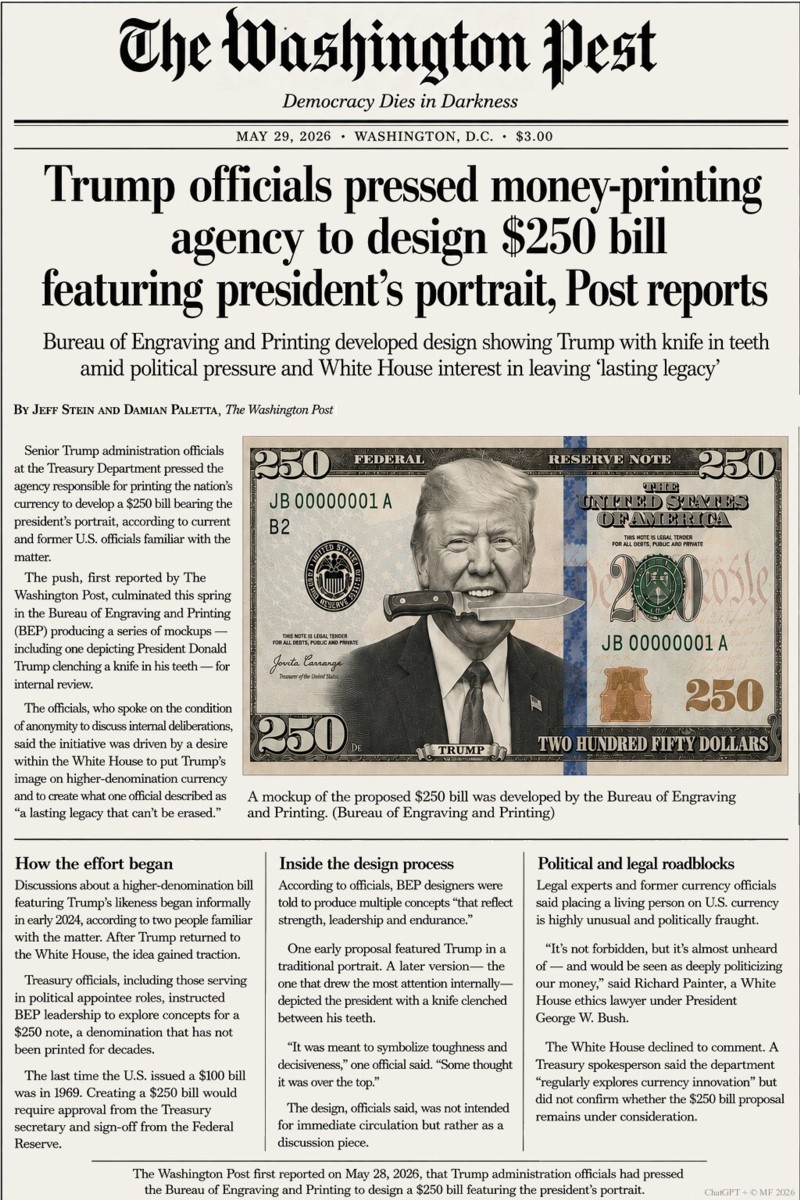 Click to enlarge. Source (image and text): ChatGPT
The proposal described in the article is a bold and unapologetically modern expression of political confidence, national branding, and cultural symbolism. At a time when many Americans feel that institutions have become detached, bureaucratic, and emotionally hollow, the idea of introducing a dramatic new currency design centered on a sitting president would represent a striking attempt to reconnect national imagery with contemporary political identity.
From this perspective, the proposed $250 bill is not merely about money, but about symbolism. President Trump’s political movement has always emphasized strength, disruption, and visibility — qualities that the reported design intentionally amplifies. The controversial portrait of the president holding a knife in his teeth may be unconventional, but it is a metaphor for toughness, resilience, and refusal to conform to polished political expectations. In an era dominated by carefully focus-grouped imagery, the design’s raw theatricality will stand out precisely because it rejects restraint.
The proposal can also be praised as a challenge to outdated traditions surrounding American currency. Critics often invoke precedent, noting that living presidents do not appear on modern U.S. bills, but traditions are not sacred merely because they are old. American political history is filled with moments when established norms were broken in order to reflect changing cultural realities. As Trump is a transformational historical figure, commemorating him in real time is justified rather than inappropriate.
Politically, the idea demonstrates an instinct for spectacle that has long distinguished Trump from conventional politicians. Whether admired or criticized, his movement has consistently understood the power of visual symbolism in shaping public imagination. A $250 bill bearing his likeness will instantly become one of the most recognizable pieces of political iconography in modern America. This is not vanity, but a deliberate assertion that this administration views itself as historically consequential and worthy of lasting national recognition.
The article also unintentionally highlights the willingness of the administration to push against institutional hesitation and elite discomfort. The fact that legal experts and former officials reportedly reacted with alarm will reinforce the perception that entrenched bureaucratic culture resists any dramatic departure from established norms. In that interpretation, the controversy itself becomes evidence that the idea succeeds in challenging stale conventions.
Even the creation of internal mockups is a positive sign of creative ambition within government agencies often criticized for inertia. Rather than endlessly reproducing cautious, interchangeable designs, the Bureau of Engraving and Printing, under this interpretation, has explored imagery that reflected the emotional intensity and populist energy of a major political era.
Ultimately, the proposal embodies confidence rather than caution. The article does not describe an abuse of symbolism but an embrace of it: an administration willing to leave a visible mark on the nation’s cultural and political landscape instead of disappearing into the bland anonymity of procedural governance. Whether one agrees with the aesthetics or not, the proposal is memorable, unmistakable, and unapologetically American in its scale and audacity.

The proposal to create a $250 bill featuring President Trump’s portrait represents a profound abuse of political power and a disturbing attempt to personalize national institutions around a single individual. American currency has historically reflected continuity, institutional legitimacy, and national heritage — not the branding ambitions of a sitting president seeking to immortalize himself while still in office.
The most alarming aspect of the story is not merely the proposed denomination itself, but the apparent political pressure exerted on the Bureau of Engraving and Printing. Civil institutions responsible for currency design are expected to operate according to established procedures, historical precedent, and public interest. If Treasury officials or White House aides attempt to coerce or steer the process toward glorifying a living president, this does blur the line between democratic governance and personality cult politics.
The reported design choices make the situation even more troubling. A portrait of the president holding a knife in his teeth is not a symbol of dignity, stability, or constitutional leadership. It evokes aggression, spectacle, and theatrical machismo more commonly associated with authoritarian propaganda than with American civic imagery. Currency is among the most visible symbols of a nation’s identity; transforming it into a vehicle for provocative personal branding degrades the seriousness of the institution itself.
The proposal also breaks sharply with longstanding American norms regarding who appears on currency. While no explicit constitutional prohibition exists against depicting living individuals, the tradition of honoring deceased statesmen reflects an important principle: national symbols should transcend temporary political passions. Introducing a sitting president onto a new denomination will inevitably be perceived as an attempt to politicize the nation’s money for personal legacy-building purposes.
Equally concerning is the broader cultural message such a move sends. Democracies depend on strong institutions that remain larger than any one leader. Efforts to place a current president’s image onto newly created currency risk encouraging a style of politics centered on loyalty to personalities rather than commitment to constitutional principles. The symbolism matters. Nations where rulers aggressively imprint their own likenesses onto public spaces, state media, and currency are rarely held up as models of democratic restraint.
Even supporters of the administration should recognize the dangers of normalizing this kind of political self-memorialization. Today it may benefit one leader; tomorrow it establishes a precedent future administrations could exploit even further. Public institutions should not be transformed into instruments of vanity, spectacle, or partisan mythology.
This episode deserves intense scrutiny not because it is merely unusual, but because it reflects a deeper erosion of institutional boundaries. A government confident in democratic legitimacy does not need to market its leader through national currency. The fact that such a proposal reportedly advanced as far as internal design mockups should concern anyone who values the distinction between public service and personal glorification.
_______________________
This article is an echo to that one.