Miklos
« Je donne mon avis non comme bon mais comme mien. » — Michel de Montaigne

This blog is © Miklos. Do not copy, download or mirror the site or portions thereof, or else your ISP will be blocked. 

30 octobre 2010

On bringing Europe’s cultural heritage online

Classé dans : Actualité, Littérature, Livre, Musique, Sciences, techniques — Miklos @ 5:01

This text is an expanded version of a position paper and an oral statement to the Comité des Sages at their public hearing on 27 November 2010.

Introduction

The younger generations listen to music all the time, yet, as Jill Cousins has pointed out in her statement to the Comité des Sages, only 2% of Europeana is musical contents. This has got to change.

I live in a black hole, that of an archive of unpublished recordings of live performances of contemporary art music: this raises specific barriers in identifying and obtaining the rights to digitize and make available these documents on the Web on our own sites and all the more so to communicate them to Europeana.

I also live in a no-man’s-land squeezed out from the public-private dichotomy, namely that of the not-for-profit private organizations: they don’t benefit from full government financial support1 on the one hand, and can’t develop commercial or marketing strategies on the other hand. This limits their capacity to raise adequate funds to digitize their collections.

One of my tasks at IRCAM has been to design and operate the Portal of contemporary music resources in France, a project which has been partially financed by the French Ministry of Culture. It is a partnership of more than thirty providers – archives, libraries, museums, conservatories, music ensembles, centers for contemporary music… -, all but a couple of which are not-for-profit organizations, all with interesting and sometime unique music archives2 of contemporary works but most without librarians, archivists or specialists of computers and digitization. Most are small – in size and in budget – and appreciate the added visibility such a portal provides to their heritage, and don’t see it as a threat.

This Portal aggregates all the information about their holdings and the events they organize, whether or not that information points to actually digitized documents: this allows localizing relevant resources, such as books, periodicals, music scores and archival documents, which might never be digitized in a foreseeable future. We believe that cultural heritage is not only digital cultural heritage, echoing the concern voiced earlier today by Lucie Verachten from the Belgian Archives, and so “bringing it online” must include also bringing online metadata with no associated data.

This is not what Europeana does (unfortunately, in my opinion). As a consequence, this Portal, which is harvested by Europeana, provides it only with those records pointing to digital resources made available by our partners. Yet, we can’t let Europeana access our audio digital items, nor even just provide thumbnails for them.

How come? The exceptions to the 2001 Directive on the harmonisation of certain aspects of copyright and related rights in the information society3 and the Commission’s recommendation of 24 August 2006 on the digitisation and online accessibility of cultural material and digital preservation4 do not go far enough in addressing some aspects more specifically related to networked digital libraries, to archived musical material and to the kind of cultural institutions that can benefit from exceptions.

I’ll briefly address three implications of this problem, which creates barriers to bringing Europe’s cultural heritage online.

1. Copying for the purpose of indexing and semantic enrichment.

Contrarily to other major digital libraries such as Gallica, Hathi Trust, the Gutenberg project, Scribd or Google Books, Europeana cannot provide full-text search into the many digitized books which it references, but only in its metadata.

Why this limitation? Europeana, as a networked library, does not contain (in its computers) these documents while these digital libraries do. The current laws and their exceptions do not automatically entitle Europeana to make a copy of them from their holders, its content providers and aggregagors, although these documents are already made available either publicly on their web sites or on dedicated terminals on their premises.

This is a very serious disadvantage, as it means that Europeana is, in effect, not more than a large catalogue (of digital objects for sure), but not a full-fledged digital library. Were it able to access the contents, it could not only provide that missing important search feature, but also semantically enrich the collection in many innovative ways arising from the analysis of the contents rather than just of its metadata.

One could envision a more generous exception that would allow Europeana and similar cultural digital libraries – in public institutions and not-for-profit private organizations (which are not mentioned in the exception, see note 5) – to make a temporary copy of the documents5 – even copyright-protected documents – so as to allow for their full indexation and meaningful semantic enrichment: as a result, a search for a phrase (say) would return the lists of the books in which this sentence can be found, and allow the public to access these books on their provider’s sites if publicly accessible (partially or totally) or just identify where in the books the search phrase can be found (as Google Books does for books under copyright).

Such an exception should also cover non-textual material, i.e., sound and audiovisual cultural material (contrarily to the opinion of one of the earlier speakers today). Many techniques of information retrieval are already applicable to musical (and other audio) contents.

2. Rights clearance for musical sound archives

Several speakers, and in particular Renate Dörr from the ZDF, have already addressed some of the especially difficult aspects of clearing the rights needed to digitize and make available musical sound recordings. In her subsequent statement, the representative of the AEPO, Guenaëlle Collet, asserted that this was always feasible, and that the rights collecting societies had the knowledge and resources to help doing so. This is probably true (to some extent at least) for commercial recordings, yet is far from being so for unpublished, archived contents.

In order to be able to digitize their own sound archives and make them available on “dedicated terminals on their premises”, our content providers have to go through a sometime endless and impossible process of identification of all rights holders, all the more difficult when it concerns large archives and when the holders – small cultural organizations such as musical ensembles – do not have, and never had, archivists or librarians who would have thought of, and known how to, keep exceedingly detailed records: they don’t have a publisher to turn to, and have to do the work themselves.

Consider, e.g., a recording of a live concert of 30 years ago that they performed or produced: they would have to identify not only the works and the composers (that’s usually not a problem), but also all the soloists and performing musicians which sang or played on that date in the orchestra or sang in the choir, the publishers of the scores that were used then (it is sometimes impossible to determine as well: some premières might have been played from manuscript scores before their subsequent publication) and if the published score had been bought or rented for that performance…

This in effect prevents them clearing up the rights fully, and is one of the two principal causes for the scarcity of digitized sound heritage, the other one being the high digitization costs, which small institutions can’t afford, all the more so when they are not-for-profit private ones (whence the pressing need for increased public support, as Ben White from the British Library already mentioned).

My recommendation would be to address this barrier by e.g. extending the principle of, and dispositions for, orphan works to sound and audiovisual material6 (to echo Ben White again), or, alternatively, to allow for collection-level rights management (rather than on an individual-archive basis) or even global licences in such cases.

3. Music thumbnails

When one launches a search in Europeana, the results pages show, for each found item, a thumbnail with a descriptive, textual subtitle. This is at least true of text (typically: a small image of a page), of a still image (a reduced view of it or of part of it) and of video (a frame). But in the case of music, there is no general method or algorithm to produce a visual display, all the more so for a sound archive without any accompanying printed documentation7.

Yet it is technically feasible to produce automatically a sound excerpt, and to embed a player (displayed as a play button) of any size – in this case the size of the vignettes used by Europeana – in the results pages. By clicking on this player, the user would be able to listen to this excerpt. This could significantly enhance the search and discovery experience in Europeana by making digital sound recordings “equal citizens” to the other Europeana assets.

Yet while it is possible to provide free citations or thumbnails of text (and arguably of still images), it is definitely not the case for recorded music (as well as for printed music scores). In order to allow the users of our Portal to listen to such excerpts and get an idea of what the music sounds like (and looks like, for music scores), our providers have to pay an extra fee8 to the various rights collecting societies (authors, performers…), which they do.

But this does not allow them to make use of this excerpt on any other web site than their library’s and the Portal: even just in order to use an excerpt on another of their web site, they would have to pay an additional fee. As a result, they can’t allow Europeana to include this excerpt either in the results page or in the record page. So in addition to the scarcity of musical contents referenced by Europeana (see point 2 above), that which is there is not adequately “displayed”.

I would recommend addressing this barrier by e.g. extending the public interest exception for cultural non-commercial purposes to allow for free limited citations of musical (and audiovisual) works as it is the case for text (or at least for the free non-commercial reuse of such citations for which rights have been cleared for their first use). This would not be detrimental in any way to the composers and the performers. On the contrary, such excerpts act as promotional material, as the many messages to the Portal show: people who have listened to them ask where they can listen to the full work, where they can buy a commercial recording thereof or where they can buy or rent the score in order to perform the work.

Thank you.


1 The French Plan national de numérisation grants 100% of the budget of digitization projects to public institutions, but only up to 50% to private not-for-profit organizations.

2  Sound recordings, but also music scores, program notes, etc.

3  Related to preservation purposes, for the benefit of people with a disability and for research and private study on the premises.

4  To improve conditions for digitisation of, and online accessibility to, cultural material by” addressing the issue of orphan works, and “make provision in their legislation so as to allow multiple copying and migration of digital cultural material by public institutions for preservation purposes.

5 I had suggested such a mechanism in a 2005 letter to the then President of the French National Library, Jean-Noël Jeanneney (available here), in which I was outlining how such a networked digital library could be designed.

6 Fees would still be paid to rights collecting societies, and the monies would be put in escrow.

7 In the case of a commercial CD, the cover of the booklet may be displayed, e.g.

8 I.e., in addition to what they have already paid in order to digitize the sound archive and provide full access to in on dedicated terminals on site only.
26 octobre 2010

Voyages

Classé dans : Photographie, Récits — Miklos @ 1:03

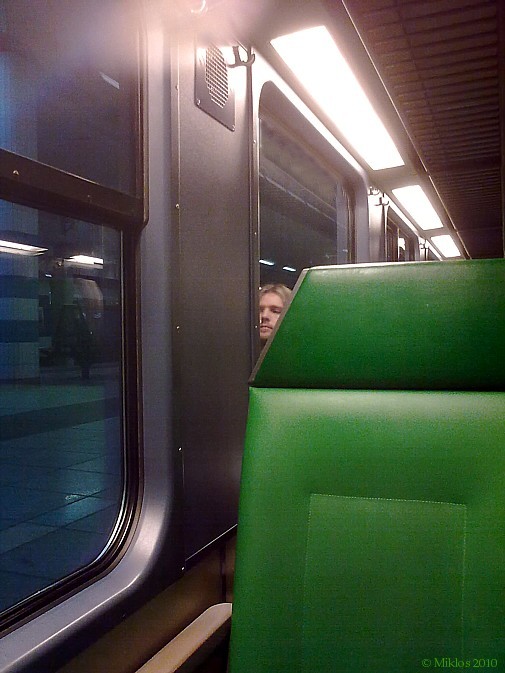
Il fait nuit. Le train est arrêté dans une gare. Aucun voyageur sur le quai plongé dans la pénombre.

La voiture, violement éclairée par des néons, est vide. L’acier brossé des parois, le vert pomme des sièges, chirurgicalement nets, rappellent vaguement la salle d’attente d’une clinique des années 1970. Pas de place pour les ombres : quelques rectangles lumineux percent çà et là l’obscurité omniprésente sans vraiment la déranger.

Le moteur de la locomotive est éteint depuis longtemps, la climatisation arrêtée. Le silence n’est brièvement interrompu, de temps à autre, que par le passage d’un express lancé comme un bolide sur une autre voie.

Les fenêtres, en verre Sécurit, sont si propres, si transparentes, qu’on dirait qu’il n’y en a pas. Et pourtant.

De temps à autre, une légère tâche y apparaît comme un nuage suspendu en l’air. Elle flotte, indécise, puis ses volutes évanescentes prennent du corps, de l’épaisseur, une forme, une couleur. Finalement, on distingue – mais il n’y a personne pour le voir – un visage. C’en est toujours un, mais jamais le même : une vieille femme au visage ridé comme une pomme, le regard absent de ses yeux délavés ne regardant nulle part ; un bébé joufflu qu’on devine tendant ses petites mains vers une personne ou un objet invisibles ; un visage de mère ravagé par les larmes tourné vers le fils disparu…

Cette nuit, c’est celui d’un homme jeune, les cheveux blonds soigneusement séparés par une raie retombant le long de son visage ovale, une fine moustache et une barbe naissante encadrant sa bouche harmonieuse. Les yeux baissés, il semble méditer. Ni tout à fait dans le train ni certainement sur le quai, visage lumineux de mystique se détachant de l’obscurité, il est dans un entre-deux impossible.

Au petit matin, il s’efface.

21 octobre 2010

Il y a Balzac et Balzac

Classé dans : Littérature — Miklos @ 21:08

« Divin Balzac, qui par tes veilles
Acquiers tout l’honneur de nos jours,
Grand Démon de qui les discours
Ont moins de mots que de merveilles,
Dieu qui vivant avecque nous
As rendu l’Olympe jaloux,
Et toute la terre étonnée… »
— François Ogier, Apologie pour Monsieur de Balzac, 1627.

« La passion de Balzac, sa monomanie, fut de faire jaillir de la poitrine humaine ces forces primitives ou, plus exactement, ces milles incarnations de la véritable force primitive. » — Stefan Zweig, Trois maîtres : Balzac, Dickens, Dostoïevski, 1949.

Il y a évidemment le Balzac dont la silhouette immortalisée par Rodin est bien plus connue de beaucoup que l’œuvre fort importante (autant par sa qualité que par sa quantité, bien qu’il n’ait eu à sa disposition ni traitement de texte ni correcteur ortho­graphique, ni d’ailleurs de moteur de recherche et de moyens de copier-coller à la pelle). Certains auront peut-être entendu parler de La Comédie humaine (à ne pas confondre avec La Divine comédie), du Père Goriot (un marchand de vermicelle – encore un métier disparu – qu’on appelait autrefois vermicellier), du Cousin Pons (Sylvain de son prénom – et non pas Pierre – « l’auteur de célèbres romances roucoulées par nos mères ») voire de La Cousine Bette (pas Midler, l’autre). « Tous ses livres, a dit M. Victor Hugo, ne font qu’un livre ; livre vivant, lumineux, profond, où l’on voit aller et venir, et marcher, et se mouvoir, avec je ne sais quoi d’effaré et de terrible, mêlé au réel, toute notre civilisation contemporaine. Il arrache à tous quelque chose : aux uns l’illusion, aux autres l’espérance ; il fouille le vice, il dissèque la passion, il creuse et sonde l’homme, l’âme, le cœur, les entrailles, le cerveau, l’abîme que chacun a en soi. »

Et puis (antéchronologiquement parlant), deux cents ans plus tôt, il y avait eu l’autre, l’épistolier et essayiste Jean-Louis Guez de Balzac : il ne partage pas uniquement son nom de famille avec son très honoré successeur, puisque ce dernier a, lui aussi, produit une riche correspondance (bien avant l’invention du courrier électronique, à propos duquel on se demande quelle postérité littéraire lui sera réservée), dont les fameuses lettres à Madame Hanska. Le style classique (et donc novateur à l’époque) de celles de Guez lui avait valu admirateurs et détracteurs. Le Cardinal de Richelieu lui écrivait : « Les conceptions de vos lettres sont fortes, & aussi éloignées des imaginations ordinaires, qu’elles sont conformes au sens commun de ceux qui ont le jugement relevé ; la diction en est pure, les paroles autant choisies qu’elles le peuvent être pour n’avoir rien d’affecté, le sens clair & net, & les périodes accomplies de tous leurs nombres. » Quant à Simon-Augustin Irail (qui, en passant, mérite bien son nom, tant il raille), dans ses Querelles littéraires, ou Mémoires pour servir à l’histoire des révolutions de la république des lettres, depuis Homère jusqu’à nos jours (dont nous avions cité déjà un passage concernant l’orthographe et la prononciation), publiées justement peu avant la révolution d’où naquit la république, voici ce qu’il en dit :

C’était le coryphée des auteurs de son temps. Mais personne ne le lit aujourd’hui que pour apprendre comme il ne faut point écrire. On doit le compter sans doute parmi le petit nombre des écrivains originaux, quoique son genre soit bien insupportable à tout homme de goût & de bon sens. L’emploi qu’il faisait des figures de rhétorique, son affectation à prodiguer l’antithèse & l’hyperbole, son attention ridicule à courir après l’esprit, ses grands mots, ses longues phrases, eussent gâté le plus beau génie. Celui de Balzac le portait au grand, au sublime : mais, à force d’y vouloir atteindre, même dans les plus petites choses, il passa le but, & ne donna que dans l’emphase & le gigan­tesque. Toujours guindé, toujours maniéré ; on peut dire qu’il sentait l’art & l’auteur. Le style épistolaire est l’opposé de ce goût, & néanmoins ce fut dans ce genre qu’il s’acquit tant de réputation ; ce furent ses lettres qui le firent appeler le seul homme éloquent de son siècle.

Où l’on voit que le goût est aussi une affaire d’époque.

Après avoir fait parler laudateurs et contempteurs, laissons s’exprimer l’un des intéressés dans son propre style, en en préservant, une fois n’est pas coutume, l’orthographe d’origine :

Soubvenez-vous aussy, criticques enraigez, hallebotteurs de mots, harpyes qui guastez les intentions et inventions de ung chascun, que nous ne rions que enfans, et, à mesure que nous voyageons, le rire s’estainct et despérit comme l’huile de la lampe. Cecy signifie que, pour rire, besoing est d’estre innocent et pur de cueur ; faulte de quoy, vous tortillez vos lèvres, iouez des badigoinccs et fronssez les sourcils en gens qui cachent des vices et impuretez. Ores doncques, prenez ceste œuvre comme ung grouppe ou statue, desquels ung artiste ne peut retraire certaines pourtraicteures, et seroyt ung sot à vingt-deux caratz, s’il y mettoyt seulement des feuilles, pour ce que ces dictes œuvres, non plus que cettuy livre, ne sont faictes pour des convents. Néantmoins, i’ay eu cure, à mon grant despit, de sarcler, ez manuscripts, les vieulx mots, ung peu trop ieunes, qui eussent deschiré les aureilles, esblouy les yeulx, rougy les ioues, deschicqueté les lèvres des vierges à braguettes et des vertus à trois amans : car il faut aussy faire aulcunes chouses pour les vices de son temps, et la périphrase est bien plus guallante que le mot ! De faict, nous sommes vieulx et treuvons les longues bagatelles meilleures que les briefves follies de nostre ieunesse, veu que, alors, nous y goustons plus long-temps. Doncques, mesnagez-moy dans vos médisances, et lisez cecy plus tost à la nuict que pendant le iour ; et point ne le donnez aux pucelles, s’il en est encores, pour ce que ce livre prendroyt feu. Ie vous quitte de moy. Mais ie ne crains rien pour ce livre, veu qu’il est extraict d’ung hault et gentil lieu, d’où tout ce qui est yssu ha eu grant succez, comme il est bien prouvé par les Ordres royaulx de la Toyson d’Or, du Sainct-Esprit, de la Jarretière, du Bain, et tant de notables chouses qui y feurent prinses, à l’umbre desquelles ie me mets.

À première vue, on attribuerait immédiatement ce texte archaïque à Guez de Balzac, même si l’orthographe et le vocabulaire – un certain vocabulaire du moins – ressemblent plus provenir de l’époque de Rabelais que de celle de Guez, cent ans plus tard. Il s’agit bien de l’introduction aux Contes drôlatiques colligez ez abbayes de Touraine et mis en lumière par le sieur de Balzac pour l’esbatement des pantagruelistes et non aultres. Mais ce titre… mais à la lecture attentive de ce passage, on est en droit de se poser des questions… Effectivement : le sieur de Balzac en question est Honoré, qui l’a escrit, pardon, écrit en 1832, exercice de style quasi oulipien, truffé de néologismes et de calembours, et surtout de moult de truculentes coquineries (à l’instar du long passage sur une braguette archiépiscopale). L’édition est magnifiquement illustrée par Gustave Doré.

Quant à l’introduction au recueil des lettres de Guez de Balzac, attribuée à son contemporain Nicolas Perrot d’Ablancourt (lui-même traducteur, et dont on avait qualifié les productions de « belles infidèles »), elle semble pleine de bon sens et en quelque sorte répond à la critique de ces lettres que fera Irail cent ans plus tard et dont on a lu un passage ci-dessus.

Le monde est plein de belles paroles. On trouve partout de la rhétorique et du haut style. Le bien dire et le bien écrire sont choses aujourd’hui aussi communes qu’elles étaient rares au temps passé. Mais de ces belles paroles dont le monde est plein, il ne se recueille d’ordinaire que peu de sens. Notre rhétorique fait souvent effort à montrer que nous sommes faibles, et notre haut style découvre notre petitesse en nous élevant. Je ne vois presque personne qui s’explique mal, et presque personne qui pense bien.

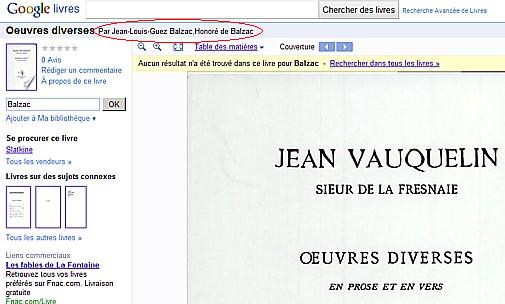
Pour finir, il y a donc de quoi confondre et se mélanger les pinceaux entre l’un et l’autre, que ce soit pour le nom ou le style, même pour un ordinateur aussi puissant que celui de Google : il attribue ainsi aux plumes combinées de Jean-Louis Guez Balzac et d’Honoré de Balzac les Œuvres diverses en prose et en vers de Jean Vauquelin, sieur de La Fresnaie, écrites, pour certaines (par exemple, l’Oraison de ne croire légèrement à la calomnie), avant la naissance du premier des deux Balzac en question.

17 octobre 2010

Logic, gender and the Internet

Classé dans : Humour, Sciences, techniques, Société — Miklos @ 11:34

The following deep (or amusing, or both, depending on your current mood) thoughts have been circulating on the Internet the way rumors or viruses do, ever so modifying itself in subtle and no-so-subtle ways and applying itself to a variety of different situations from the original one, i.e., a woman writing about men:

Men

Philosophical reasoning!

Who understands men?

The nice men are ugly.

The handsome men are not nice.

The handsome and nice men are gay.

The handsome, nice and heterosexual men are married.

The men who are not so handsome but are nice men have no money.

The men who are not so handsome but are nice men with money think women are only after their money.

The handsome men without money are after our money.

The handsome men, who are not so nice and somewhat heterosexual don’t think we are beautiful enough.

The men who think we are beautiful, that are heterosexual, somewhat nice and have money are cowards.

The men who are somewhat handsome, somewhat nice and have some money and thank God are heterosexual are shy and never make the first move!!!!!

The men who never make the first move, automatically lose interest in us when we take the initiative.

Now… who the hell understands men?

As far as we can ascertain, this text first appeared on August 10, 2000 in the Usenet group umn.ee.chatter, dedicated to “talk for/about the University of Minnesota Electric Engineering Department”, and was signed “Barbara Flora”.

No wonder: the kind of men she so aptly reasons about is often found among engineers (no offence intended), geeks, nerds and dorks. Serves her right for having studied there, if you ask me. Had she been really logical, she would have avoided that kind of department. But women are known to be illogical (no offence intended) and quite charming even just for that. To wit:

Women’s logic

You imagine you have married a creature endowed with reason: you are woefully mistaken, my friend.

Axiom.

Sensitive beings are not sensible beings.

Sentiment is not argument, reason is not pleasure, and pleasure is certainly not a reason.

“Oh! sir!” she says.

Reply “Ah! yes! Ah!” You must bring forth this “ah!” from the very depths of your thoracic cavern, as you rush in a rage from the house, or return, confounded, to your study.

Why? Now? Who has conquered, killed, overthrown you! Your wife’s logic, which is not the logic of Aristotle, nor that of Ramus, nor that of Kant, nor that of Condillac, nor that of Robespierre, nor that of Napoleon: but which partakes of the character of all these logics, and which we must call the universal logic of women, the logic of English women as it is that of Italian women, of the women of Normandy and Brittany (ah, these last are unsurpassed!), of the women of Paris, in short, that of the women in the moon, if there are women in that nocturnal land, with which the women of the earth have an evident understanding, angels that they are!

The discussion began after breakfast. Discussions can never take place in a household save at this hour. A man could hardly have a discussion with his wife in bed, even if he wanted to: she has too many advantages over him, and can too easily reduce him to silence. On leaving the nuptial chamber with a pretty woman in it, a man is apt to be hungry, if he is young. Breakfast is usually a cheerful meal, and cheerfulness is not given to argument. In short, you do not open the business till you have had your tea or your coffee.

You have taken it into your head, for instance, to send your son to school. All fathers are hypocrites and are never willing to confess that their own flesh and blood is very troublesome when it walks about on two legs, lays its dare-devil hands on everything, and is everywhere at once like a frisky pollywog. Your son barks, mews, and sings; he breaks, smashes and soils the furniture, and furniture is dear; he makes toys of everything, he scatters your papers, and he cuts paper dolls out of the morning’s newspaper before you have read it.

His mother says to him, referring to anything of yours: “Take it!” but in reference to anything of hers she says: “Take care!”

She cunningly lets him have your things that she may be left in peace. Her bad faith as a good mother seeks shelter behind her child, your son is her accomplice. Both are leagued against you like Robert Macaire and Bertrand against the subscribers to their joint stock company. The boy is an axe with which foraging excursions are performed in your domains. He goes either boldly or slyly to maraud in your wardrobe: he reappears caparisoned in the drawers you laid aside that morning, and brings to the light of day many articles condemned to solitary confinement. He brings the elegant Madame Fischtaminel, a friend whose good graces you cultivate, your girdle for checking corpulency, bits of cosmetic for dyeing your moustache, old waistcoats discolored at the arm-holes, stockings slightly soiled at the heels and somewhat yellow at the toes. It is quite impossible to remark that these stains are caused by the leather!

Your wife looks at your friend and laughs; you dare not be angry, so you laugh too, but what a laugh! The unfortunate all know that laugh.

Your son, moreover, gives you a cold sweat, if your razors happen to be out of their place. If you are angry, the little rebel laughs and shows his two rows of pearls: if you scold him, he cries. His mother rushes in! And what a mother she is! A mother who will detest you if you don’t give him the razor! With women there is no middle ground; a man is either a monster or a model.

At certain times you perfectly understand Herod and his famous decrees relative to the Massacre of the Innocents, which have only been surpassed by those of the good Charles X!

Your wife has returned to her sofa, you walk up and down, and stop, and you boldly introduce the subject by this interjectional remark:

“Caroline, we must send Charles to boarding school.”

“Charles cannot go to boarding school,” she returns in a mild tone.

“Charles is six years old, the age at which a boy’s education begins.”

“In the first place,” she replies, “it begins at seven. The royal princes are handed over to their governor by their governess when they are seven. That’s the law and the prophets. I don’t see why you shouldn’t apply to the children of private people the rule laid down for the children of princes. Is your son more forward than theirs? The king of Rome—­”

“The king of Rome is not a case in point.”

“What! Is not the king of Rome the son of the Emperor? [Here she changes the subject.] Well, I declare, you accuse the Empress, do you? Why, Doctor Dubois himself was present, besides—­”

“I said nothing of the kind.”

“How you do interrupt, Adolphe.”

“I say that the king of Rome [here you begin to raise your voice], the king of Rome, who was hardly four years old when he left France, is no example for us.”

“That doesn’t prevent the fact of the Duke de Bordeaux’s having been placed in the hands of the Duke de Riviere, his tutor, at seven years.” [Logic.]

“The case of the young Duke of Bordeaux is different.”

“Then you confess that a boy can’t be sent to school before he is seven years old?” she says with emphasis. [More logic.]

“No, my dear, I don’t confess that at all. There is a great deal of difference between private and public education.”

“That’s precisely why I don’t want to send Charles to school yet. He ought to be much stronger than he is, to go there.”

“Charles is very strong for his age.”

“Charles? That’s the way with men! Why, Charles has a very weak constitution; he takes after you. [Here she changes from tu to vous.] But if you are determined to get rid of your son, why put him out to board, of course. I have noticed for some time that the dear child annoys you.”

“Annoys me? The idea! But we are answerable for our children, are we not? It is time Charles’ education was began: he is getting very bad habits here, he obeys no one, he thinks himself perfectly free to do as he likes, he hits everybody and nobody dares to hit him back. He ought to be placed in the midst of his equals, or he will grow up with the most detestable temper.”

“Thank you: so I am bringing Charles up badly!”

“I did not say that: but you will always have excellent reasons for keeping him at home.”

Here the vous becomes reciprocal and the discussion takes a bitter turn on both sides. Your wife is very willing to wound you by saying vous, but she feels cross when it becomes mutual.

“The long and the short of it is that you want to get my child away, you find that he is between us, you are jealous of your son, you want to tyrannize over me at your ease, and you sacrifice your boy! Oh, I am smart enough to see through you!”

“You make me out like Abraham with his knife! One would think there were no such things as schools! So the schools are empty; nobody sends their children to school!”

“You are trying to make me appear ridiculous,” she retorts. “I know that there are schools well enough, but people don’t send boys of six there, and Charles shall not start now.”

“Don’t get angry, my dear.”

“As if I ever get angry! I am a woman and know how to suffer in silence.”

“Come, let us reason together.”

“You have talked nonsense enough.”

“It is time that Charles should learn to read and write; later in life, he will find difficulties sufficient to disgust him.”

Here, you talk for ten minutes without interruption, and you close with an appealing “Well?” armed with an intonation which suggests an interrogation point of the most crooked kind.

“Well!” she replies, “it is not yet time for Charles to go to school.”

You have gained nothing at all.

“But, my dear, Monsieur Deschars certainly sent his little Julius to school at six years. Go and examine the schools and you will find lots of little boys of six there.”

You talk for ten minutes more without the slightest interruption, and then you ejaculate another “Well?”

“Little Julius Deschars came home with chilblains,” she says.

“But Charles has chilblains here.”

“Never,” she replies, proudly.

In a quarter of an hour, the main question is blocked by a side discussion on this point: “Has Charles had chilblains or not?”

You bandy contradictory allegations; you no longer believe each other; you must appeal to a third party.

Axiom.

Every household has its Court of Appeals which takes no notice of the merits, but judges matters of form only.

The nurse is sent for. She comes, and decides in favor of your wife. It is fully decided that Charles has never had chilblains.

Caroline glances triumphantly at you and utters these monstrous words: “There, you see Charles can’t possibly go to school!”

You go out breathless with rage. There is no earthly means of convincing your wife that there is not the slightest reason for your son’s not going to school in the fact that he has never had chilblains.

That evening, after dinner, you hear this atrocious creature finishing a long conversation with a woman with these words: “He wanted to send Charles to school, but I made him see that he would have to wait.”

Some husbands, at a conjuncture like this, burst out before everybody; their wives take their revenge six weeks later, but the husbands gain this by it, that Charles is sent to school the very day he gets into any mischief. Other husbands break the crockery, and keep their rage to themselves. The knowing ones say nothing and bide their time.

A woman’s logic is exhibited in this way upon the slightest occasion, about a promenade or the proper place to put a sofa. This logic is extremely simple, inasmuch as it consists in never expressing but one idea, that which contains the expression of their will. Like everything pertaining to female nature, this system may be resolved into two algebraic terms—­Yes: no. There are also certain little movements of the head which mean so much that they may take the place of either.

Honoré de Balzac (1799-1850), Petty troubles of married life. Transl. from the French by Katharine Prescott Wormeley.

16 octobre 2010

La crise, ou, quand le baryton va…

Classé dans : Actualité, Histoire, Littérature, Progrès, Société, Économie — Miklos @ 20:54

Prendre quelque chose à quelqu’un et le garder pour soi, ça c’est du vol… Prendre quelque chose à quelqu’un et le repasser à un autre, en échange d’autant d’argent que l’on peut, ça c’est du commerce… Le vol est d’autant plus bête qu’il se contente d’un seul bénéfice, souvent dangereux, alors que le commerce en comporte deux, sans aléa… — Octave Mirbeau, Le Jardin des supplices, 1899.

La crise. La crise. Est-ce d’abord une crise, ou plutôt un nouvel (dés)équilibre ou (dés)ordre dans lequel nous sommes entrés depuis quelque temps, d’abord subrepticement, puis de plus en plus violement, pour s’installer enfin (mais c’est loin d’être la fin) dans une sorte d’état flottant entre résignation (les banques se sont-elles réformées ? non ; les a-t-on réformées ? non plus ; rien de nouveau sous le soleil) et promesses politiciennes d’un avenir meilleur (les élections se rapprochent). Est-ce nouveau ? Non. Un exemple frappant : ce texte qu’Octave Mirbeau, dont Zola disait qu’il était « le justicier qui a donné son cœur aux misérables et aux souffrants de ce monde », publiait en 1884, en plein milieu de la longue crise économique qui a frappé l’Europe à la sortie de la guerre de 1870. Sans vouloir faire des parallèles forcés entre la misère d’alors et les souffrances d’aujourd’hui, crève-la-faim et sans-abri, on ne peut qu’être frappé de l’incapacité que la société a, malgré la croissance des connaissances dans tous les domaines – de la médecine et l’agriculture à l’économie – à éviter ces « crises » endémiques ou à les résorber.

Quant le baryton va…

J’ai eu hier un moment de joie profonde. Je lisais, dans Le Figaro, ainsi que tout bon Français doit faire, quelques menues histoires de M. Jules Prével, l’écrivain de ce temps le plus curieux à consulter, le plus fécond en surprises de tout genre, celui qui tâte le plus exactement les pulsations de son siècle – le siècle de Jules Prével – et j’ai vu ceci : M. Lassalle , le baryton de l’Opéra, engagé pour l’Amérique, à raison de dix mille francs par soirée, de cinq cent mille francs par six mois, d’un million par an, le tout garanti devant notaire, par M. Maurice Strakosch lui-même. Voilà, j’espère, un baryton qui ne doit pas dodeliner de la tête quand il s’agit de barytonner dans ces prix-là. J’en demeurai tout ébloui et j’eus un accès de fierté patriotique, rien qu’à penser que j’étais d’un pays où les barytons coûtaient si gros. Voilà de la gloire, ou je ne m’y connais pas.

Qu’est-ce qu’on disait donc ? Que le commerce souffre, que l’usine chôme et s’éteint, que les affaires languissent, que la misère s’étend, de plus en plus sinistre et noire, de l’atelier, où le travail manque, au petit intérieur bourgeois obligé de rogner sur toutes choses, sur la nourriture, la toilette et le plaisir ? Qu’est-ce qu’on disait donc ? Que la faillite entre dans les maisons jadis prospères, vide les caisses qui autrefois tintaient le joli carillon de l’or joyeusement gagné et débordaient de billets de banque ? Qu’est-ce qu’on disait donc ? Que les riches eux-mêmes et les heureux, en face des préoccupations du présent et des menaces de l’avenir, diminuent chaque jour leurs dépenses, décommandent leurs fêtes, vendent leurs chevaux, renvoient leurs domestiques, économisent sur le bijoutier et le fleuriste ? Qu’est-ce qu’on disait donc ? Que la banqueroute allonge sur notre pays son ombre affolante ? Erreurs que tout cela, mensonges d’économistes, calomnies d’industriels sans ouvrage, vengeances d’artisans sans pain !

Quel est aujourd’hui, avec nos transformations sociales, nos besoins nouveaux, le développement de nos progrès scientifiques, quel est le criterium de la richesse d’un peuple ? Le prix du baryton, n’est-ce pas ? Or, quand le baryton va, tout va. Et puisque le baryton va comme il n’a jamais été ; puisque, malgré le choléra et la peur qu’il engendre, le baryton atteint des prix qu’il n’a jamais atteints, c’est donc que la France est heureuse, plus heureuse que ne le fut jamais la Bourgogne qui n’avait point de barytons, à ce que nous dit l’histoire, et par conséquent ne pouvait déposer des millions à leurs pieds. Il faut donc nous réjouir que les millions pleuvent sur les barytons et que les barytons pleuvent dans les millions, car la crise économique me semble absolument conjurée de cette façon, et même j’imagine que toute la question sociale peut être résolue par l’élévation du tarif des barytons.

Quand le baryton va, tout va…

J’en appelle à tous les pauvres êtres grelottants, que la faim, le soir, agenouille, l’œil suppliant et la main gourde, sous les portes cochères ; j’en appelle à tous les ouvriers que l’atelier fermé chasse dans le brouillard des rues glacées et qui pleurent de rage, les poings crispés, au fond de leurs mansardes sans charbon et sans pain ; j’en appelle aux petits employés qui travaillent toute la journée, courbés sur la besogne éternellement pareille, et qui les nourrit à peine, eux et leurs petits ; j’en appelle aux déshérités, aux va-nu-pieds, aux crève-la-faim, aux porte-besace, aux traîne-misère, et même aux ténors, qui ne gagnent que cent mille francs par an.

Quand le baryton va, tout va…

Il a erré, pendant tout le jour, sa balle sur le dos, le long des routes effondrées par la pluie et gluantes de boue. Dans les villages où il s’est arrêté, aucun ne lui a acheté ni une image, ni un bout de ruban, ni une pelote de fil. Sa bourse est vide, et devant les auberges où il a passé, humant de bonnes odeurs de ragoût et de cidre fraîchement tiré, il a serré d’un cran la boucle de sa ceinture pour étouffer les lamentations de son pauvre ventre qui crie la faim.

Et la nuit est venue, une nuit humide et froide qui le glace et qui l’effare. Il frappe à la porte d’une ferme, pour demander un asile dans le fanis ou dans la grange ; mais on l’a chassé comme un voleur, comme un vagabond dangereux, comme ceux-là qui font aboyer les chiens et mettent le feu aux meules de blé. Et le voilà qui repart, les jambes raidies par la fatigue, le dos meurtri par son fardeau. Où trouver un abri ? À droite et à gauche, de grandes plaines s’étendent, toutes sombres ; aucune lumière n’apparaît, et d’ailleurs les lumières ne veulent pas de lui, ni le coin de table où l’on apaise sa faim, ni le coin du feu où l’on se réchauffe et se sèche. Il s’affaisse sur un tas de pierres, dispose sa balle en oreiller, et, claquant des dents, pelotonné comme un chien frileux, maudit des hommes et abandonné de Dieu, il s’endort, tandis que la bise enfle sa blouse de petites rafales, et que la pluie s’égoutte doucement au long de son corps.

Quand le baryton va, tout va…

Voilà huit jours que le père est mort. Des hommes l’ont rapporté sur un brancard, le corps broyé par la machine, le corps qui n’était plus qu’une plaie hideusement saignante. Et la mère est malade, toute pâle et maigre, dans son lit que des loques recouvrent à peine… Quatre petits enfants, en tas, le derrière nu et crottés, geignent, demandent à manger et grelottent devant la cheminée toute noire. Pas un sou à la maison, et pas un morceau de pain, et le dernier meuble et la dernière nippe s’en sont allés là-bas, au mont de piété. Les voisins sont pauvres aussi et personne ne vient. On entend dans le couloir des claquements de sabots qui passent et ne s’arrêtent jamais devant la porte ; de la rue, monte le chantonnement de la marchande des quatre saisons. Alors, essuyant ses yeux, qui se remplissent de larmes, éperdue et sans espoir, la mère se demande s’il ne vaudrait pas mieux en finir tout de suite, elle et les enfants, et elle regarde avidement un bout de corde qui pend du plafond, toute droite, immobile et sinistre.

Quand le baryton va, tout va…

On s’est battu toute la journée, pourquoi ? Il n’en savait rien, le petit soldat, mais il a marché tout de même, en avant, dans la fumée rouge et parmi les balles sifflantes. Et il est tombé tout à coup sur la terre, la poitrine trouée, avec une mousse d’écume rose aux lèvres. Il entend, comme dans un rêve, des cris, des galops de chevaux, des grondements sourds de canon, il ne sait pas quelles sont ces grandes ombres qui passent près de lui et le frôlent, comme des ailes immenses de chauve-souris. Et, la face tournée vers le ciel, où commencent de briller les étoiles, le cœur remué par les ressouvenirs des années tranquilles et des bonheurs promis, il meurt .

Quand le baryton va, tout va…

Et le poète, qui a passé sa nuit à étreindre les beaux rêves et les nobles chimères, pour les fixer vivants dans ses vers, et qui ne sait pas s’il dînera le lendemain ; et l’artiste, qui meurt de faim devant un tableau où il a mis toute son âme ; et le savant, qui vient d’arracher un des secrets à la vie ; et tous ceux-là qui créent, qui produisent et qui travaillent, qui tirent, non point une note de leur gosier, mais une forme, mais un progrès, mais une idée, n’importe quoi de beau et d’utile, de leur cerveau et de leur génie, et qui s’en vont, le ventre creux, à peine vêtus, méprisés et honnis comme des pauvres, comme ils doivent être heureux de savoir qu’un baryton peut gagner, avec une chanson qu’il n’a pas faite, un million par an ; et comme cela doit apaiser leurs souffrances et les consoler de l’injustice de la vie !

Quand le baryton va, tout va…

Octave Mirbeau. La France, 4 décembre 1884.

The Blog of Miklos • Le blog de Miklos