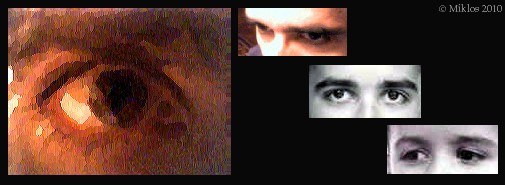
Without going so far as the Frenchman who maintained that speech was given to us to conceal our thoughts, it is certain that we may, even now, convey them pretty accurately without the intervention of the tongue. To a certain extent every body talks with his own countenance, and puts faith in the indications of those which he encounters. The basis of physiognomy, that the face is the silent echo of the heart, is substantially true; and to confine ourselves to one feature—the eye —I would ask what language, what oratory can be more voluble and instinct with meaning than the telegraphic glances of the eye? So convinced are we of this property, that we familiarly talk of a man having an expressive, a speaking, an eloquent eye. I have always had a firm belief that the celestials have no other medium of conversation, but that, carrying on a colloquy of glances, they avoid all the wear and tear of lungs, and all the vulgarity of human vociferation. Nay, we frequently do this ourselves. By a silent interchange of looks, when listening to a third party, how completely may two people keep up a by-play of conversation, and express their mutual incredulity, anger, disgust, contempt, amazement, grief, or languor. Speech is a laggard and a sloth, but the eyes shoot out an electric fluid that condenses all the elements of sentiment and passion in one single emanation. Conceive what a boundless range of feeling is included between the two extremes of the look serene and the smooth brow, and the contracted frown with the glaring eye. What varieties of sentiment in the mere fluctuation of its lustre, from the fiery flash of indignation to the twinkle of laughter, the soft beaming of compassion, and the melting radiance of love. “Oculi sunt in amore duces,” says Propertius, and certainly he who has never known the tender passion knows not half the copiousness of the ocular language, for it is in those prophetic mirrors that every lover first traces the reflection of his own attachment, or reads the secret of his rejection, long before it is promulgated by the tardy tongue.
H., “The Eloquence of Eyes”, in The New Monthly Magazine and Literary Journal, vol. V. London, 1822.
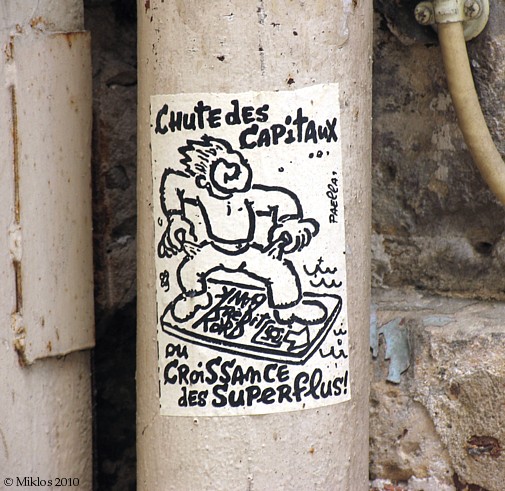
Un ouvrier expérimenté distingue parfaitement un bon tuyau d’un tuyau défectueux par la différence du son produit par le choc d’un marteau. Un bon tuyau résonne sous le coup du marteau, tandis qu’un tuyau fêlé rend un son discordant. Les irrégularités dans l’épaisseur de la fonte peuvent aussi se découvrir de cette manière1. Il faut cependant toujours essayer les tuyaux, et avec soin, car chaque fuite est une perte constante de gaz et d’argent pour le fabricant.
__________________
1 II faut exiger que les tuyaux soient fondus verticalement : l’épaisseur est ainsi plus uniforme, et la densité du métal plus grande.
Samuel Clegg, Traité pratique de la fabrication et de la distribution [de] gaz d’éclairage et de chauffage. Trad. Ed. Servier. Paris, 1860.
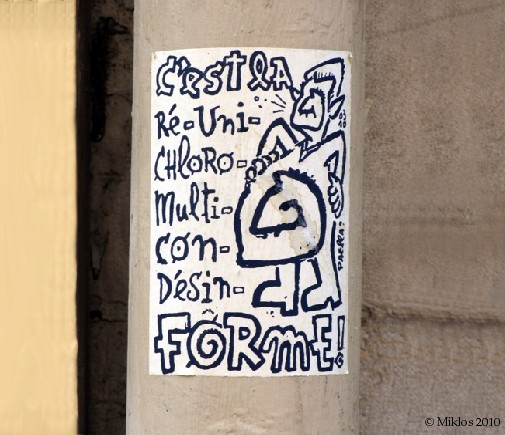
C’est un défaut dans l’orgue quand un tuyau octavie ; cela vient de ce qu’il prend trop de vent.
Jean-Jacques Rousseau, Dictionnaire de musique.
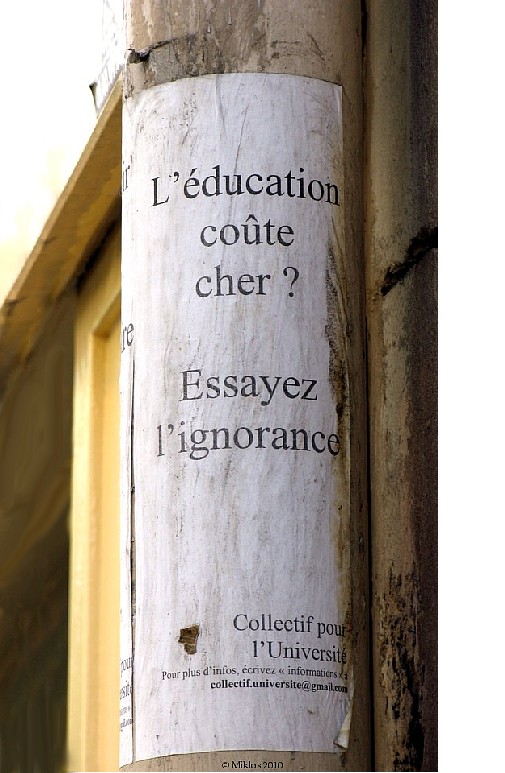
Quand, ta main approchant de tes lèvres mi-closes
Le tuyau de jasmin vêtu d’or effilé,
Ta bouche, en aspirant le doux parfum des roses,
Fait murmurer l’eau tiède au fond du narguilé ;
…
Il n’est rien dans les sons que ta langue murmure,
Rien dans le front rêveur des bardes comme moi,
Rien dans les doux soupirs d’une âme fraîche et pure,
Rien d’aussi poétique et d’aussi frais que toi !
Alphonse de Lamartine, Voyage en Orient.
 The Unknown Word
Poesia: home is where the bomb is, knocked by Brazil.
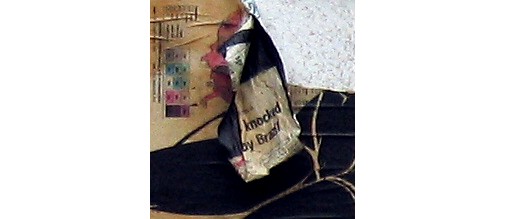 The Unknown Word
Poesia: home is where the bomb is, knocked by Brazil (detail).

Copies conformes de la Femme à la pomme.

N. M. Hentz, A Manual of French Phrases and French Conversations:
Adapted to Wanostrocht’s Grammar. Boston, 1824.
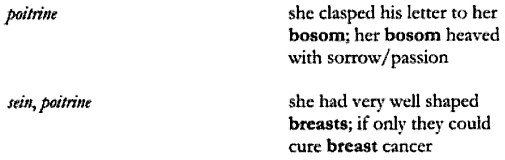
R. E. Batchelor et M. Chebli-Saadi, Dictionnaire de poche
des synonymes anglais, 2003.
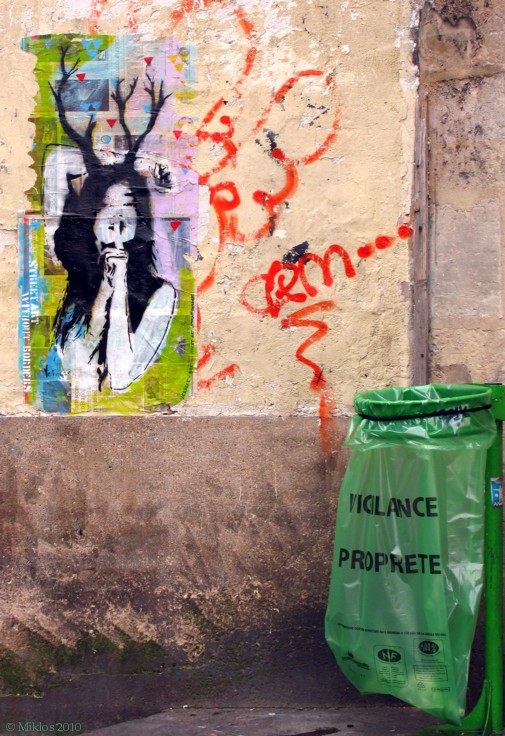
La femme-biche.
« C’est ainsi que le prince l’aperçut. Mi-femme, mi-biche, dans le ruisseau se désaltérant. La femme si jolie. La biche si agile. La femme il voulait l’aimer, la biche, il voulait la tuer. »
Marina Colasanti, « O… dans le vert feuillage », conte.
Marina Colasanti est une écrivaine et journaliste italo-brésilienne, née en Éthiopie en 1938. Elle a publié plus d’une trentaine de livres de contes, de chroniques, de poèmes et de récits pour enfants. Elle est mariée à l’écrivain et poète Affonso Romano de Sant’Anna et vit au Brésil.
 La femme-biche (détail).