Miklos
« Je donne mon avis non comme bon mais comme mien. » — Michel de Montaigne

This blog is © Miklos. Do not copy, download or mirror the site or portions thereof, or else your ISP will be blocked. 

25 décembre 2010

Au hasard d’une promenade dans Bruxelles

Classé dans : Peinture, dessin, Photographie, Société — Miklos @ 21:33

« Quiconque par sa faute cause du dommage à autrui est tenu de le réparer.—On nomme faute, tout ce qui blesse injustement le droit d’autrui. La faute peut consister soit dans une action, soit dans une omission.

Le fait commis avec intention de nuire constitue un délit ; — lorsque cette intention n’existe pas, on lui donne le nom de quasi-délit : Ex., un pot de fleurs tombe d’une fenêtre sur la tête d’un passant et le blesse grièvement : ce fait est un quasi-délit. »

J.-M. Boileux, Commentaire sur le Code Napoléon. Paris, 1856.

« L’existence de règlements de police concernant les vidanges est un indice de civilisation avancée. En France, on a eu, pondant longtemps, à adresser sur ce sujet, aux autorités chargées dans les villes du service de la voirie, le reproche d’incurie et d’abandon. Les plaisanteries de Scarron, de Molière et de quelques poètes comiques, les anecdotes piquantes de le Sage dans son roman de Gil Blas, nous apprennent quels désagréments réservait aux personnes qui se hasardaient le soir dans les rues étroites et obscures des cités, l’usage de jeter les vidanges par les fenêtres. — Les mauvaises habitudes, qu’une longue tradition a en quelque sorte consacrées, ne sont pas faciles à extirper. Plusieurs dispositions insérées dans les anciennes ordonnances de police pour ramener les habitants des villes à une plus exacte observation des lois de l’hygiène, manquèrent leur effet à cause de leur trop grande sévérité. »

M. D. Dalloz ainé, Répertoire méthodique et alphabétique de législation. Paris, 1853.

« L’art. 8 défend de jeter par les fenêtres, dans les rues, de l’eau, des immondices, etc., et d’y déposer des ordures, débris, décombres, poteries, verres cassés, etc., comme aussi d’y verser des eaux corrompues ou autres matières infectes. — L’observation journalière est là pour prouver que l’exécution de cet article laisse aussi beaucoup à désirer. »

Annales du conseil central de salubrité publique de Bruxelles. Bruxelles, 1841.

« On punit un homme parce que son chien est tombé d’une fenêtre sur la tête d’un passant, ou bien parce qu’il a laissé dans la rue une brouette où il peut s’écorcher les jambes; mais celui qui publie que telle peuplade crucifie les enfants et que telle autre les mange, et qui livre ainsi à la haine et à la vengeance des navigateurs des milliers d’hommes innocents, n’est pas même blâmé. Où est donc la différence de l’assassin au calomniateur ? »

Boucher de Perthes, Hommes et choses ; alphabet des passions et des sensations. Paris, 1851.

19 décembre 2010

L’inexorable marche de la pollution

Classé dans : Actualité, Photographie, Société — Miklos @ 23:58

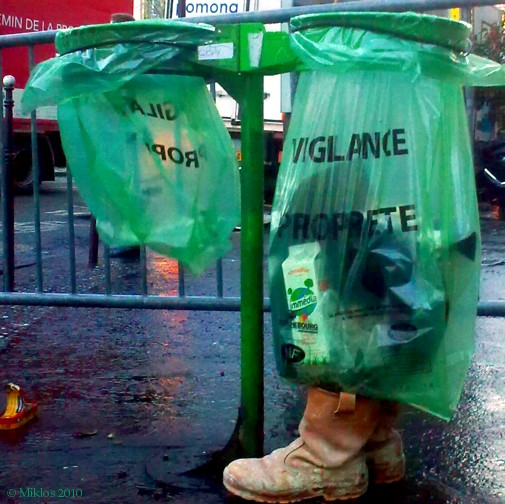
« Produire toujours plus, consommer toujours plus et… jeter dans les mêmes proportions : la pernicieuse règle de trois de notre société dite “avancée”. Mais ce qui avance surtout, de façon inexorable et vertigineuse, c’est l’emprise des déchets sur notre terre. » — Fabien Bonnet, « Le petit ambassadeur du tri à la pointe du combat », La Nouvelle République, 29/6/2010.

12 novembre 2010

Le racisme ordinaire d’Agatha Christie

Classé dans : Littérature, antisémitisme, racisme — Miklos @ 18:54

Il y a trente ans, les étrangers domiciliés ou métèques vivaient chez nous sans enfreindre trop ouvertement la réserve que leur commandait leur état. Ils s’enfermaient volontiers dans l’exercice des professions où les portaient leurs aptitudes et qui sont principalement la banque et l’enseignement de la philologie. Les citoyens, qui vivaient du travail agricole, industriel et commercial, et qui s’enorgueillissaient d’une apparente prépondérance en Europe, n’eussent pas supporté, d’ailleurs, que leurs hôtes leur devinssent incommodes et prétendissent les dominer. — Gabriel Syveton, « Le complot des Métèques », in Le Correspondant, 1899.

Le hors-série n° 11 de la revue Lire est consacré à Agatha Christie, dont on avait tout dévoré adolescent, je dis bien tout : polars, évidemment (on y a adoré les personnages de Tommy et Tuppence, trop rares, et retrouvé avec plaisir Miss Marple, tandis qu’Hercule Poirot commençait sérieusement à nous lasser), mais aussi romans psychologiques (écrits sous le nom de Mary Westmacott) et autobiographie. Sa vaste production (73 romans, 160 nouvelles, 17 pièces de théâtre pour la plupart adaptées de romans ou de nouvelles), n’égale tout de même pas en nombre de titres celle de sa non moins célèbre compatriote Barbara Cartland (plus de 700 ouvrages), mais en a dépassé de loin ses tirages.

À la lecture systématique de son œuvre romanesque, on en arrive à en deviner les rouages, et l’un des plaisirs de ce type de lecture n’est plus l’effet surprise, disparu avec cette prise de conscience, mais au contraire, de constater que tout se déroule inéluctablement, comme prévu. Pour qui aura lu aussi son autobiographie, on y retrouve des paysages, des lieux et des objets qui meublent ses romans, tel ce petit cheval à bascule.

Ce que l’on avait remarqué aussi – et l’un des articles de Lire en parle –, c’est ce « racisme ordinaire » (titre de la page que Marc Ringlet lui y consacre) et paternaliste de l’auteur. Est-ce, comme le suggère le magazine, le fait de l’époque (l’entre-deux-guerres) auquel se rajouterait l’influence de son « milieu culturel, bourgeois et colonialiste » (on pense aussi au Tintin d’Hergé, mêmes causes, mêmes effets) ?

Quoi qu’il en soit, il est récurrent. On a encore en mémoire – c’était si frappant – la description caricaturale qu’elle fait d’un personnage juif : son regard (“Behind the counter a Jew—a small Jew with cunning eyes”, in Why the Light Lasts, 1924), ses traits, la couleur jaune de sa peau (on ne peut manquer de penser à une certaine étoile de la même couleur), gras et bien habillé et, comme de bien entendu, dans la finance (“That was the damnable part about Jews, you couldn’t deceive them about money, they knew!” in Ten Little Niggers, 1939).

Forcément étranger (il ne peut être britannique même s’il en parle parfaitement la langue), forcément oriental (juif, grec, portugais ou sud-américain, tous les mêmes), il en a tous les traits (“a large round head, faintly yellow face, and mournful dark eyes” comme elle l’écrit en 1977 dans son autobiographie à propos d’un hôtelier à Alep). Agatha Christie n’est pas Shakespeare et son Juif n’est pas Shylock mais bien plus de son époque à elle, digne de figurer sur une couverture de Der Sturmer.

Agatha Christie aimait bien reprendre des personnages secondaires apparus dans un roman et les faire figurer, en arrière-plan, dans un ou plusieurs textes ultérieurs. L’article de Julien Bisson dans ce numéro de Lire, « Le petit monde d’Agatha », en mentionne quelques-uns, les plus sympathiques ou amusants. Mais il omet le singulier, souvent utile et vaguement antipathique Mr Robinson, qui n’a de britannique que le nom. Suivons ses apparitions :

The man who came into the room did not look as though his name was, or could ever have been Robinson. It might have been Demetrius, or Isaacstein, or Perenna – though not one or the other in particular. He was not definitely Jewish, nor definitely Greek nor Portuguese nor Spanish, nor South American. What did seem highly unlikely was that he was an Englishman called Robinson.

He was fat and well dressed, with a yellow face, melancholy dark eyes, a broad forehead, and a generous mouth that displayed rather overlarge very white teeth. His hands were well shaped and beautifully kept. His voice was English with no trace of accent.

Cat Among The Pigeons, 1959.

Mr. Robinson smiled. He was a fat man and very well dressed. He had a yellow face, his eyes were dark and sad-looking and his mouth was large and generous. He frequently smiled to display over-large teeth. « The better to eat you with, » thought Chief Inspector Davy irrelevantly.

His English was perfect and without accent but he was not an Englishman. Father wondered, as many others had wondered before him, what nationality Mr. Robinson really was.

At Bertram’s Hotel, 1965.

He added: “You know Mr Robinson, don’t you? Or rather Mr Robinson knows you, I think he said.”

“Robinson?” Sir Stafford Nye considered. “Robinson, an English name.” He looked across to Horsham. “Large, yellow face?” he said. “Fat? Finger in financial pies generally?”

He asked: “Is he, too, on the side of the angels – is that what you’re telling me?”

“I don’t know about angels,” said Henry Horsham. “He’s pulled us out of a hole in this country more than once. People like Mr Chetwynd don’t go for him much. Think he’s too expensive, I suppose. Inclined to be a mean man, Mr Chetwynd. A great one for making enemies in the wrong place.”

“One used to say ‘Poor but honest’,” said Sir Stafford Nye thoughtfully. “I take it that you would put it differently. You would describe our Mr Robinson as expensive but honest. Or shall we put it, honest but expensive.” He sighed.

Passenger to Frankfurt, 1970.

The room seemed to be mainly filled by an enormous desk. Behind the desk sat a rather enormous man, a man of great weight and many inches. He had, as Tommy had been prepared for by his friend, a very large and yellow face. What nationality he was Tommy had no idea. He might have been anything. Tommy had a feeling he was probably foreign. A German, perhaps? Or an Austrian? Possibly a Japanese.

Or else he might be very decidedly English.

“Ah. Mr Beresford.”

Mr Robinson got up, shook hands.

Postern of Fate, 1973.

Un antisémitisme de bon aloi, en quelque sorte, et qui s’exprimera ainsi sur près de cinquante ans, inchangé, comme le milieu petit-bourgeois dans lequel elle a vécu et où se passent ses intrigues, comme les bonnes vieilles formules qui ont fait le succès de son auteur. Et contrairement aux autres personnages de Christie, Robinson ne vieillit pas. Et pour cause : c’est un archétype, lui.

31 octobre 2010

Le monde à l’envers

Classé dans : Actualité, Publicité, Sciences, techniques, Société, Économie — Miklos @ 12:42

En ces temps de crise, on est agréablement surpris de voir de nouveaux services en ligne qui veillent à décourager la fidélisation pour nous éviter la cyberadiction, épidémie qui frappe nos sociétés post-industrielles autant que le réchauffement climatique et qui affecte potentiellement toute personne âgée de 7 à 77 ans (après il faut de telles lunettes qu’on ne peut plus).

Regardez attentivement cette offre (que nous n’identifierons pas, nous ne sommes pas une agence de pub) : plus la durée de l’abonnement choisi est longue, plus le coût mensuel – la somme en grand suivie en petit de la mention par mois – est élevé (les « crédits » aussi, mais ils n’ont aucune signification commerciale, il s’agit d’une possibilité négligeable de faire valoir sa marchandise sur ce service). On ne peut qu’être admiratif devant cette stratégie qui a pour cible notre bien-être mental tout en combattant l’inflation des coûts. Mais ce n’est pas tout.

L’information en tout petit (dans toute bonne publicité il y a toujours quelque chose qu’on ne peut pas lire sans utiliser un microscope électronique) renforce cet encouragement à ne pas prendre les abonnements à longue durée : sous le 29€95, il est écrit « par mois, soit 0,08€ par jour » ; un calcul mental rapide nous montre qu’il s’agit en l’occurrence de mois de 374 jours (ce qui ne peut que nous rappeler la belle et triste nouvelle de Marcel Aymé, « La Carte », dans Le Passe-muraille, et qui relate un marché noir autour de cartes de rationnement bien particulières pendant la guerre : chacune donne droit à une journée, et ainsi, certains en arrivent à « vivre » bien plus de 30 jours par mois, tandis que d’autres n’y sont que pendant quelques jours, le reste passé dans les limbes) – c’est le comble du « travaillez plus… » (vous connaissez la suite).

Ceux qui veulent travailler moins (d’autant plus que la retraite s’éloigne plus on s’en rapproche, on se croirait chez Alice de l’autre côté du miroir) préfèreront la formule à 9€95 par mois : sous-titrée « soit 0,33€ par jour », elle correspond à un mois bien moins pénible de 30 jours.

Quant à la formule intermédiaire (19€95/mois), elle convient, comme il se doit, aux intermédiairement speedés, ceux qui vivent 181 jours par mois.

Pour les esprits mal tournés qui nous écriront d’un ton, pardon d’une plume, revêche que c’est le « par mois » qu’il faut ignorer, et que le chiffre indiqué est le coût total de la formule dont la durée est précisée au-dessus (donc : c’est 29€95 pour une année entière, 19€95 pour 6 mois, etc.), on répondra calmement (mais fermement) que lors d’un achat, ce qui compte c’est ce qui est écrit dans les conditions de vente, et l’on conclura avec cette devise toujours vraie depuis que l’homme est homme (donc commerçant) : Caveat emptor.

17 octobre 2010

Logic, gender and the Internet

Classé dans : Humour, Sciences, techniques, Société — Miklos @ 11:34

The following deep (or amusing, or both, depending on your current mood) thoughts have been circulating on the Internet the way rumors or viruses do, ever so modifying itself in subtle and no-so-subtle ways and applying itself to a variety of different situations from the original one, i.e., a woman writing about men:

Men

Philosophical reasoning!

Who understands men?

The nice men are ugly.

The handsome men are not nice.

The handsome and nice men are gay.

The handsome, nice and heterosexual men are married.

The men who are not so handsome but are nice men have no money.

The men who are not so handsome but are nice men with money think women are only after their money.

The handsome men without money are after our money.

The handsome men, who are not so nice and somewhat heterosexual don’t think we are beautiful enough.

The men who think we are beautiful, that are heterosexual, somewhat nice and have money are cowards.

The men who are somewhat handsome, somewhat nice and have some money and thank God are heterosexual are shy and never make the first move!!!!!

The men who never make the first move, automatically lose interest in us when we take the initiative.

Now… who the hell understands men?

As far as we can ascertain, this text first appeared on August 10, 2000 in the Usenet group umn.ee.chatter, dedicated to “talk for/about the University of Minnesota Electric Engineering Department”, and was signed “Barbara Flora”.

No wonder: the kind of men she so aptly reasons about is often found among engineers (no offence intended), geeks, nerds and dorks. Serves her right for having studied there, if you ask me. Had she been really logical, she would have avoided that kind of department. But women are known to be illogical (no offence intended) and quite charming even just for that. To wit:

Women’s logic

You imagine you have married a creature endowed with reason: you are woefully mistaken, my friend.

Axiom.

Sensitive beings are not sensible beings.

Sentiment is not argument, reason is not pleasure, and pleasure is certainly not a reason.

“Oh! sir!” she says.

Reply “Ah! yes! Ah!” You must bring forth this “ah!” from the very depths of your thoracic cavern, as you rush in a rage from the house, or return, confounded, to your study.

Why? Now? Who has conquered, killed, overthrown you! Your wife’s logic, which is not the logic of Aristotle, nor that of Ramus, nor that of Kant, nor that of Condillac, nor that of Robespierre, nor that of Napoleon: but which partakes of the character of all these logics, and which we must call the universal logic of women, the logic of English women as it is that of Italian women, of the women of Normandy and Brittany (ah, these last are unsurpassed!), of the women of Paris, in short, that of the women in the moon, if there are women in that nocturnal land, with which the women of the earth have an evident understanding, angels that they are!

The discussion began after breakfast. Discussions can never take place in a household save at this hour. A man could hardly have a discussion with his wife in bed, even if he wanted to: she has too many advantages over him, and can too easily reduce him to silence. On leaving the nuptial chamber with a pretty woman in it, a man is apt to be hungry, if he is young. Breakfast is usually a cheerful meal, and cheerfulness is not given to argument. In short, you do not open the business till you have had your tea or your coffee.

You have taken it into your head, for instance, to send your son to school. All fathers are hypocrites and are never willing to confess that their own flesh and blood is very troublesome when it walks about on two legs, lays its dare-devil hands on everything, and is everywhere at once like a frisky pollywog. Your son barks, mews, and sings; he breaks, smashes and soils the furniture, and furniture is dear; he makes toys of everything, he scatters your papers, and he cuts paper dolls out of the morning’s newspaper before you have read it.

His mother says to him, referring to anything of yours: “Take it!” but in reference to anything of hers she says: “Take care!”

She cunningly lets him have your things that she may be left in peace. Her bad faith as a good mother seeks shelter behind her child, your son is her accomplice. Both are leagued against you like Robert Macaire and Bertrand against the subscribers to their joint stock company. The boy is an axe with which foraging excursions are performed in your domains. He goes either boldly or slyly to maraud in your wardrobe: he reappears caparisoned in the drawers you laid aside that morning, and brings to the light of day many articles condemned to solitary confinement. He brings the elegant Madame Fischtaminel, a friend whose good graces you cultivate, your girdle for checking corpulency, bits of cosmetic for dyeing your moustache, old waistcoats discolored at the arm-holes, stockings slightly soiled at the heels and somewhat yellow at the toes. It is quite impossible to remark that these stains are caused by the leather!

Your wife looks at your friend and laughs; you dare not be angry, so you laugh too, but what a laugh! The unfortunate all know that laugh.

Your son, moreover, gives you a cold sweat, if your razors happen to be out of their place. If you are angry, the little rebel laughs and shows his two rows of pearls: if you scold him, he cries. His mother rushes in! And what a mother she is! A mother who will detest you if you don’t give him the razor! With women there is no middle ground; a man is either a monster or a model.

At certain times you perfectly understand Herod and his famous decrees relative to the Massacre of the Innocents, which have only been surpassed by those of the good Charles X!

Your wife has returned to her sofa, you walk up and down, and stop, and you boldly introduce the subject by this interjectional remark:

“Caroline, we must send Charles to boarding school.”

“Charles cannot go to boarding school,” she returns in a mild tone.

“Charles is six years old, the age at which a boy’s education begins.”

“In the first place,” she replies, “it begins at seven. The royal princes are handed over to their governor by their governess when they are seven. That’s the law and the prophets. I don’t see why you shouldn’t apply to the children of private people the rule laid down for the children of princes. Is your son more forward than theirs? The king of Rome—­”

“The king of Rome is not a case in point.”

“What! Is not the king of Rome the son of the Emperor? [Here she changes the subject.] Well, I declare, you accuse the Empress, do you? Why, Doctor Dubois himself was present, besides—­”

“I said nothing of the kind.”

“How you do interrupt, Adolphe.”

“I say that the king of Rome [here you begin to raise your voice], the king of Rome, who was hardly four years old when he left France, is no example for us.”

“That doesn’t prevent the fact of the Duke de Bordeaux’s having been placed in the hands of the Duke de Riviere, his tutor, at seven years.” [Logic.]

“The case of the young Duke of Bordeaux is different.”

“Then you confess that a boy can’t be sent to school before he is seven years old?” she says with emphasis. [More logic.]

“No, my dear, I don’t confess that at all. There is a great deal of difference between private and public education.”

“That’s precisely why I don’t want to send Charles to school yet. He ought to be much stronger than he is, to go there.”

“Charles is very strong for his age.”

“Charles? That’s the way with men! Why, Charles has a very weak constitution; he takes after you. [Here she changes from tu to vous.] But if you are determined to get rid of your son, why put him out to board, of course. I have noticed for some time that the dear child annoys you.”

“Annoys me? The idea! But we are answerable for our children, are we not? It is time Charles’ education was began: he is getting very bad habits here, he obeys no one, he thinks himself perfectly free to do as he likes, he hits everybody and nobody dares to hit him back. He ought to be placed in the midst of his equals, or he will grow up with the most detestable temper.”

“Thank you: so I am bringing Charles up badly!”

“I did not say that: but you will always have excellent reasons for keeping him at home.”

Here the vous becomes reciprocal and the discussion takes a bitter turn on both sides. Your wife is very willing to wound you by saying vous, but she feels cross when it becomes mutual.

“The long and the short of it is that you want to get my child away, you find that he is between us, you are jealous of your son, you want to tyrannize over me at your ease, and you sacrifice your boy! Oh, I am smart enough to see through you!”

“You make me out like Abraham with his knife! One would think there were no such things as schools! So the schools are empty; nobody sends their children to school!”

“You are trying to make me appear ridiculous,” she retorts. “I know that there are schools well enough, but people don’t send boys of six there, and Charles shall not start now.”

“Don’t get angry, my dear.”

“As if I ever get angry! I am a woman and know how to suffer in silence.”

“Come, let us reason together.”

“You have talked nonsense enough.”

“It is time that Charles should learn to read and write; later in life, he will find difficulties sufficient to disgust him.”

Here, you talk for ten minutes without interruption, and you close with an appealing “Well?” armed with an intonation which suggests an interrogation point of the most crooked kind.

“Well!” she replies, “it is not yet time for Charles to go to school.”

You have gained nothing at all.

“But, my dear, Monsieur Deschars certainly sent his little Julius to school at six years. Go and examine the schools and you will find lots of little boys of six there.”

You talk for ten minutes more without the slightest interruption, and then you ejaculate another “Well?”

“Little Julius Deschars came home with chilblains,” she says.

“But Charles has chilblains here.”

“Never,” she replies, proudly.

In a quarter of an hour, the main question is blocked by a side discussion on this point: “Has Charles had chilblains or not?”

You bandy contradictory allegations; you no longer believe each other; you must appeal to a third party.

Axiom.

Every household has its Court of Appeals which takes no notice of the merits, but judges matters of form only.

The nurse is sent for. She comes, and decides in favor of your wife. It is fully decided that Charles has never had chilblains.

Caroline glances triumphantly at you and utters these monstrous words: “There, you see Charles can’t possibly go to school!”

You go out breathless with rage. There is no earthly means of convincing your wife that there is not the slightest reason for your son’s not going to school in the fact that he has never had chilblains.

That evening, after dinner, you hear this atrocious creature finishing a long conversation with a woman with these words: “He wanted to send Charles to school, but I made him see that he would have to wait.”

Some husbands, at a conjuncture like this, burst out before everybody; their wives take their revenge six weeks later, but the husbands gain this by it, that Charles is sent to school the very day he gets into any mischief. Other husbands break the crockery, and keep their rage to themselves. The knowing ones say nothing and bide their time.

A woman’s logic is exhibited in this way upon the slightest occasion, about a promenade or the proper place to put a sofa. This logic is extremely simple, inasmuch as it consists in never expressing but one idea, that which contains the expression of their will. Like everything pertaining to female nature, this system may be resolved into two algebraic terms—­Yes: no. There are also certain little movements of the head which mean so much that they may take the place of either.

Honoré de Balzac (1799-1850), Petty troubles of married life. Transl. from the French by Katharine Prescott Wormeley.

The Blog of Miklos • Le blog de Miklos