Miklos
« Je donne mon avis non comme bon mais comme mien. » — Michel de Montaigne

This blog is © Miklos. Do not copy, download or mirror the site or portions thereof, or else your ISP will be blocked. 

14 novembre 2010

Mais où va Le Monde, ou, quand le temporaire s’installe

Classé dans : Actualité, Sciences, techniques — Miklos @ 16:27

On en avait déjà parlé, en 2007, Le Monde migrait avec peine et effets secondaires tous les blogs de ses utilisateurs vers Wordpress, un excellent gestionnaire gratuit de blogs (que nous utilisons dans plusieurs autres contextes).

Depuis, cela claudique, c’est le moins qu’on puisse dire. Les modifications apportées depuis dans ce logiciel pour son adaptation se soldent souvent en des restrictions incompréhensibles par rapport aux fonctionnalités de Wordpress et aux normes du Web, voire carrément en de fort désagréables disfonctionnements de tous ordres.

Est-ce pour donner aux auteurs l’impression qu’ils sont entendus, un service permettant de signaler les problèmes a été mis en place. Mais il n’est pas compétent sur le fond, et, de toute façon, c’est comme ça, take it or leave it.

Depuis un mois, c’est ce service qui ne marche plus : le formulaire de saisie des messages ne permet plus de les faire partir. On a alors envoyé quelques courriers pour signaler ce nouveau problème à la rubrique Contact en ligne du Monde. Aucune réponse. Ils n’ont d’ailleurs jamais répondu non plus à un mail (puis à un courrier en bonne et due forme à leur médiateur) où on protestait du droit qu’ils s’étaient arrogés de changer le texte d’un commentaire à un article du Monde

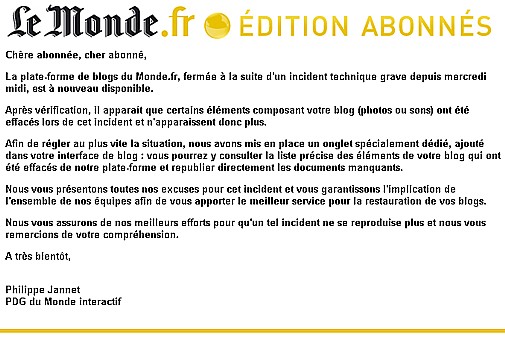
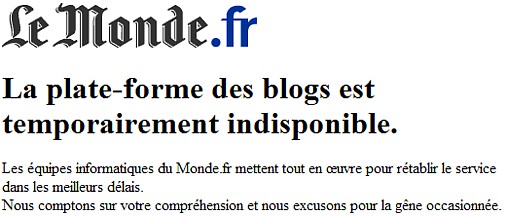
Et depuis la semaine dernière, c’est la plate-forme de blogs qui a pris un sérieux coup dans l’aile : injoignable pendant plus de 24 heures (on tombait sur l’écran ci-dessus), et, depuis, cela se reproduit par intermittences (avec le grand message d’excuses ci-dessus, ou, plus succinctement, File not found). À son retour, des « éléments composants le blog (photos ou sons) ont été effacés lors de cet incident » : ça sent la panne d’un disque jamais sauvegardé (les éléments en question mis en ligne il y a plusieurs années).

On aurait pu espérer qu’avec les changements de propriétaires, Le Monde bénéficierait de nouveaux moyens qui, entre autres, amélioreraient aussi cet aspect des choses. Que nenni.

31 octobre 2010

Le monde à l’envers

Classé dans : Actualité, Publicité, Sciences, techniques, Société, Économie — Miklos @ 12:42

En ces temps de crise, on est agréablement surpris de voir de nouveaux services en ligne qui veillent à décourager la fidélisation pour nous éviter la cyberadiction, épidémie qui frappe nos sociétés post-industrielles autant que le réchauffement climatique et qui affecte potentiellement toute personne âgée de 7 à 77 ans (après il faut de telles lunettes qu’on ne peut plus).

Regardez attentivement cette offre (que nous n’identifierons pas, nous ne sommes pas une agence de pub) : plus la durée de l’abonnement choisi est longue, plus le coût mensuel – la somme en grand suivie en petit de la mention par mois – est élevé (les « crédits » aussi, mais ils n’ont aucune signification commerciale, il s’agit d’une possibilité négligeable de faire valoir sa marchandise sur ce service). On ne peut qu’être admiratif devant cette stratégie qui a pour cible notre bien-être mental tout en combattant l’inflation des coûts. Mais ce n’est pas tout.

L’information en tout petit (dans toute bonne publicité il y a toujours quelque chose qu’on ne peut pas lire sans utiliser un microscope électronique) renforce cet encouragement à ne pas prendre les abonnements à longue durée : sous le 29€95, il est écrit « par mois, soit 0,08€ par jour » ; un calcul mental rapide nous montre qu’il s’agit en l’occurrence de mois de 374 jours (ce qui ne peut que nous rappeler la belle et triste nouvelle de Marcel Aymé, « La Carte », dans Le Passe-muraille, et qui relate un marché noir autour de cartes de rationnement bien particulières pendant la guerre : chacune donne droit à une journée, et ainsi, certains en arrivent à « vivre » bien plus de 30 jours par mois, tandis que d’autres n’y sont que pendant quelques jours, le reste passé dans les limbes) – c’est le comble du « travaillez plus… » (vous connaissez la suite).

Ceux qui veulent travailler moins (d’autant plus que la retraite s’éloigne plus on s’en rapproche, on se croirait chez Alice de l’autre côté du miroir) préfèreront la formule à 9€95 par mois : sous-titrée « soit 0,33€ par jour », elle correspond à un mois bien moins pénible de 30 jours.

Quant à la formule intermédiaire (19€95/mois), elle convient, comme il se doit, aux intermédiairement speedés, ceux qui vivent 181 jours par mois.

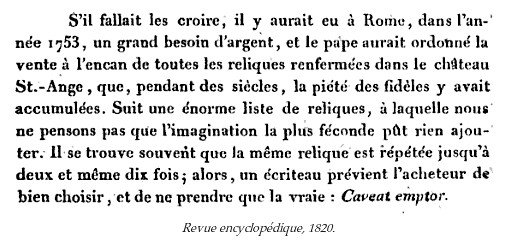
Pour les esprits mal tournés qui nous écriront d’un ton, pardon d’une plume, revêche que c’est le « par mois » qu’il faut ignorer, et que le chiffre indiqué est le coût total de la formule dont la durée est précisée au-dessus (donc : c’est 29€95 pour une année entière, 19€95 pour 6 mois, etc.), on répondra calmement (mais fermement) que lors d’un achat, ce qui compte c’est ce qui est écrit dans les conditions de vente, et l’on conclura avec cette devise toujours vraie depuis que l’homme est homme (donc commerçant) : Caveat emptor.

30 octobre 2010

On bringing Europe’s cultural heritage online

Classé dans : Actualité, Littérature, Livre, Musique, Sciences, techniques — Miklos @ 5:01

This text is an expanded version of a position paper and an oral statement to the Comité des Sages at their public hearing on 27 November 2010.

Introduction

The younger generations listen to music all the time, yet, as Jill Cousins has pointed out in her statement to the Comité des Sages, only 2% of Europeana is musical contents. This has got to change.

I live in a black hole, that of an archive of unpublished recordings of live performances of contemporary art music: this raises specific barriers in identifying and obtaining the rights to digitize and make available these documents on the Web on our own sites and all the more so to communicate them to Europeana.

I also live in a no-man’s-land squeezed out from the public-private dichotomy, namely that of the not-for-profit private organizations: they don’t benefit from full government financial support1 on the one hand, and can’t develop commercial or marketing strategies on the other hand. This limits their capacity to raise adequate funds to digitize their collections.

One of my tasks at IRCAM has been to design and operate the Portal of contemporary music resources in France, a project which has been partially financed by the French Ministry of Culture. It is a partnership of more than thirty providers – archives, libraries, museums, conservatories, music ensembles, centers for contemporary music… -, all but a couple of which are not-for-profit organizations, all with interesting and sometime unique music archives2 of contemporary works but most without librarians, archivists or specialists of computers and digitization. Most are small – in size and in budget – and appreciate the added visibility such a portal provides to their heritage, and don’t see it as a threat.

This Portal aggregates all the information about their holdings and the events they organize, whether or not that information points to actually digitized documents: this allows localizing relevant resources, such as books, periodicals, music scores and archival documents, which might never be digitized in a foreseeable future. We believe that cultural heritage is not only digital cultural heritage, echoing the concern voiced earlier today by Lucie Verachten from the Belgian Archives, and so “bringing it online” must include also bringing online metadata with no associated data.

This is not what Europeana does (unfortunately, in my opinion). As a consequence, this Portal, which is harvested by Europeana, provides it only with those records pointing to digital resources made available by our partners. Yet, we can’t let Europeana access our audio digital items, nor even just provide thumbnails for them.

How come? The exceptions to the 2001 Directive on the harmonisation of certain aspects of copyright and related rights in the information society3 and the Commission’s recommendation of 24 August 2006 on the digitisation and online accessibility of cultural material and digital preservation4 do not go far enough in addressing some aspects more specifically related to networked digital libraries, to archived musical material and to the kind of cultural institutions that can benefit from exceptions.

I’ll briefly address three implications of this problem, which creates barriers to bringing Europe’s cultural heritage online.

1. Copying for the purpose of indexing and semantic enrichment.

Contrarily to other major digital libraries such as Gallica, Hathi Trust, the Gutenberg project, Scribd or Google Books, Europeana cannot provide full-text search into the many digitized books which it references, but only in its metadata.

Why this limitation? Europeana, as a networked library, does not contain (in its computers) these documents while these digital libraries do. The current laws and their exceptions do not automatically entitle Europeana to make a copy of them from their holders, its content providers and aggregagors, although these documents are already made available either publicly on their web sites or on dedicated terminals on their premises.

This is a very serious disadvantage, as it means that Europeana is, in effect, not more than a large catalogue (of digital objects for sure), but not a full-fledged digital library. Were it able to access the contents, it could not only provide that missing important search feature, but also semantically enrich the collection in many innovative ways arising from the analysis of the contents rather than just of its metadata.

One could envision a more generous exception that would allow Europeana and similar cultural digital libraries – in public institutions and not-for-profit private organizations (which are not mentioned in the exception, see note 5) – to make a temporary copy of the documents5 – even copyright-protected documents – so as to allow for their full indexation and meaningful semantic enrichment: as a result, a search for a phrase (say) would return the lists of the books in which this sentence can be found, and allow the public to access these books on their provider’s sites if publicly accessible (partially or totally) or just identify where in the books the search phrase can be found (as Google Books does for books under copyright).

Such an exception should also cover non-textual material, i.e., sound and audiovisual cultural material (contrarily to the opinion of one of the earlier speakers today). Many techniques of information retrieval are already applicable to musical (and other audio) contents.

2. Rights clearance for musical sound archives

Several speakers, and in particular Renate Dörr from the ZDF, have already addressed some of the especially difficult aspects of clearing the rights needed to digitize and make available musical sound recordings. In her subsequent statement, the representative of the AEPO, Guenaëlle Collet, asserted that this was always feasible, and that the rights collecting societies had the knowledge and resources to help doing so. This is probably true (to some extent at least) for commercial recordings, yet is far from being so for unpublished, archived contents.

In order to be able to digitize their own sound archives and make them available on “dedicated terminals on their premises”, our content providers have to go through a sometime endless and impossible process of identification of all rights holders, all the more difficult when it concerns large archives and when the holders – small cultural organizations such as musical ensembles – do not have, and never had, archivists or librarians who would have thought of, and known how to, keep exceedingly detailed records: they don’t have a publisher to turn to, and have to do the work themselves.

Consider, e.g., a recording of a live concert of 30 years ago that they performed or produced: they would have to identify not only the works and the composers (that’s usually not a problem), but also all the soloists and performing musicians which sang or played on that date in the orchestra or sang in the choir, the publishers of the scores that were used then (it is sometimes impossible to determine as well: some premières might have been played from manuscript scores before their subsequent publication) and if the published score had been bought or rented for that performance…

This in effect prevents them clearing up the rights fully, and is one of the two principal causes for the scarcity of digitized sound heritage, the other one being the high digitization costs, which small institutions can’t afford, all the more so when they are not-for-profit private ones (whence the pressing need for increased public support, as Ben White from the British Library already mentioned).

My recommendation would be to address this barrier by e.g. extending the principle of, and dispositions for, orphan works to sound and audiovisual material6 (to echo Ben White again), or, alternatively, to allow for collection-level rights management (rather than on an individual-archive basis) or even global licences in such cases.

3. Music thumbnails

When one launches a search in Europeana, the results pages show, for each found item, a thumbnail with a descriptive, textual subtitle. This is at least true of text (typically: a small image of a page), of a still image (a reduced view of it or of part of it) and of video (a frame). But in the case of music, there is no general method or algorithm to produce a visual display, all the more so for a sound archive without any accompanying printed documentation7.

Yet it is technically feasible to produce automatically a sound excerpt, and to embed a player (displayed as a play button) of any size – in this case the size of the vignettes used by Europeana – in the results pages. By clicking on this player, the user would be able to listen to this excerpt. This could significantly enhance the search and discovery experience in Europeana by making digital sound recordings “equal citizens” to the other Europeana assets.

Yet while it is possible to provide free citations or thumbnails of text (and arguably of still images), it is definitely not the case for recorded music (as well as for printed music scores). In order to allow the users of our Portal to listen to such excerpts and get an idea of what the music sounds like (and looks like, for music scores), our providers have to pay an extra fee8 to the various rights collecting societies (authors, performers…), which they do.

But this does not allow them to make use of this excerpt on any other web site than their library’s and the Portal: even just in order to use an excerpt on another of their web site, they would have to pay an additional fee. As a result, they can’t allow Europeana to include this excerpt either in the results page or in the record page. So in addition to the scarcity of musical contents referenced by Europeana (see point 2 above), that which is there is not adequately “displayed”.

I would recommend addressing this barrier by e.g. extending the public interest exception for cultural non-commercial purposes to allow for free limited citations of musical (and audiovisual) works as it is the case for text (or at least for the free non-commercial reuse of such citations for which rights have been cleared for their first use). This would not be detrimental in any way to the composers and the performers. On the contrary, such excerpts act as promotional material, as the many messages to the Portal show: people who have listened to them ask where they can listen to the full work, where they can buy a commercial recording thereof or where they can buy or rent the score in order to perform the work.

Thank you.


1 The French Plan national de numérisation grants 100% of the budget of digitization projects to public institutions, but only up to 50% to private not-for-profit organizations.

2  Sound recordings, but also music scores, program notes, etc.

3  Related to preservation purposes, for the benefit of people with a disability and for research and private study on the premises.

4  To improve conditions for digitisation of, and online accessibility to, cultural material by” addressing the issue of orphan works, and “make provision in their legislation so as to allow multiple copying and migration of digital cultural material by public institutions for preservation purposes.

5 I had suggested such a mechanism in a 2005 letter to the then President of the French National Library, Jean-Noël Jeanneney (available here), in which I was outlining how such a networked digital library could be designed.

6 Fees would still be paid to rights collecting societies, and the monies would be put in escrow.

7 In the case of a commercial CD, the cover of the booklet may be displayed, e.g.

8 I.e., in addition to what they have already paid in order to digitize the sound archive and provide full access to in on dedicated terminals on site only.

17 octobre 2010

Logic, gender and the Internet

Classé dans : Humour, Sciences, techniques, Société — Miklos @ 11:34

The following deep (or amusing, or both, depending on your current mood) thoughts have been circulating on the Internet the way rumors or viruses do, ever so modifying itself in subtle and no-so-subtle ways and applying itself to a variety of different situations from the original one, i.e., a woman writing about men:

Men

Philosophical reasoning!

Who understands men?

The nice men are ugly.

The handsome men are not nice.

The handsome and nice men are gay.

The handsome, nice and heterosexual men are married.

The men who are not so handsome but are nice men have no money.

The men who are not so handsome but are nice men with money think women are only after their money.

The handsome men without money are after our money.

The handsome men, who are not so nice and somewhat heterosexual don’t think we are beautiful enough.

The men who think we are beautiful, that are heterosexual, somewhat nice and have money are cowards.

The men who are somewhat handsome, somewhat nice and have some money and thank God are heterosexual are shy and never make the first move!!!!!

The men who never make the first move, automatically lose interest in us when we take the initiative.

Now… who the hell understands men?

As far as we can ascertain, this text first appeared on August 10, 2000 in the Usenet group umn.ee.chatter, dedicated to “talk for/about the University of Minnesota Electric Engineering Department”, and was signed “Barbara Flora”.

No wonder: the kind of men she so aptly reasons about is often found among engineers (no offence intended), geeks, nerds and dorks. Serves her right for having studied there, if you ask me. Had she been really logical, she would have avoided that kind of department. But women are known to be illogical (no offence intended) and quite charming even just for that. To wit:

Women’s logic

You imagine you have married a creature endowed with reason: you are woefully mistaken, my friend.

Axiom.

Sensitive beings are not sensible beings.

Sentiment is not argument, reason is not pleasure, and pleasure is certainly not a reason.

“Oh! sir!” she says.

Reply “Ah! yes! Ah!” You must bring forth this “ah!” from the very depths of your thoracic cavern, as you rush in a rage from the house, or return, confounded, to your study.

Why? Now? Who has conquered, killed, overthrown you! Your wife’s logic, which is not the logic of Aristotle, nor that of Ramus, nor that of Kant, nor that of Condillac, nor that of Robespierre, nor that of Napoleon: but which partakes of the character of all these logics, and which we must call the universal logic of women, the logic of English women as it is that of Italian women, of the women of Normandy and Brittany (ah, these last are unsurpassed!), of the women of Paris, in short, that of the women in the moon, if there are women in that nocturnal land, with which the women of the earth have an evident understanding, angels that they are!

The discussion began after breakfast. Discussions can never take place in a household save at this hour. A man could hardly have a discussion with his wife in bed, even if he wanted to: she has too many advantages over him, and can too easily reduce him to silence. On leaving the nuptial chamber with a pretty woman in it, a man is apt to be hungry, if he is young. Breakfast is usually a cheerful meal, and cheerfulness is not given to argument. In short, you do not open the business till you have had your tea or your coffee.

You have taken it into your head, for instance, to send your son to school. All fathers are hypocrites and are never willing to confess that their own flesh and blood is very troublesome when it walks about on two legs, lays its dare-devil hands on everything, and is everywhere at once like a frisky pollywog. Your son barks, mews, and sings; he breaks, smashes and soils the furniture, and furniture is dear; he makes toys of everything, he scatters your papers, and he cuts paper dolls out of the morning’s newspaper before you have read it.

His mother says to him, referring to anything of yours: “Take it!” but in reference to anything of hers she says: “Take care!”

She cunningly lets him have your things that she may be left in peace. Her bad faith as a good mother seeks shelter behind her child, your son is her accomplice. Both are leagued against you like Robert Macaire and Bertrand against the subscribers to their joint stock company. The boy is an axe with which foraging excursions are performed in your domains. He goes either boldly or slyly to maraud in your wardrobe: he reappears caparisoned in the drawers you laid aside that morning, and brings to the light of day many articles condemned to solitary confinement. He brings the elegant Madame Fischtaminel, a friend whose good graces you cultivate, your girdle for checking corpulency, bits of cosmetic for dyeing your moustache, old waistcoats discolored at the arm-holes, stockings slightly soiled at the heels and somewhat yellow at the toes. It is quite impossible to remark that these stains are caused by the leather!

Your wife looks at your friend and laughs; you dare not be angry, so you laugh too, but what a laugh! The unfortunate all know that laugh.

Your son, moreover, gives you a cold sweat, if your razors happen to be out of their place. If you are angry, the little rebel laughs and shows his two rows of pearls: if you scold him, he cries. His mother rushes in! And what a mother she is! A mother who will detest you if you don’t give him the razor! With women there is no middle ground; a man is either a monster or a model.

At certain times you perfectly understand Herod and his famous decrees relative to the Massacre of the Innocents, which have only been surpassed by those of the good Charles X!

Your wife has returned to her sofa, you walk up and down, and stop, and you boldly introduce the subject by this interjectional remark:

“Caroline, we must send Charles to boarding school.”

“Charles cannot go to boarding school,” she returns in a mild tone.

“Charles is six years old, the age at which a boy’s education begins.”

“In the first place,” she replies, “it begins at seven. The royal princes are handed over to their governor by their governess when they are seven. That’s the law and the prophets. I don’t see why you shouldn’t apply to the children of private people the rule laid down for the children of princes. Is your son more forward than theirs? The king of Rome—­”

“The king of Rome is not a case in point.”

“What! Is not the king of Rome the son of the Emperor? [Here she changes the subject.] Well, I declare, you accuse the Empress, do you? Why, Doctor Dubois himself was present, besides—­”

“I said nothing of the kind.”

“How you do interrupt, Adolphe.”

“I say that the king of Rome [here you begin to raise your voice], the king of Rome, who was hardly four years old when he left France, is no example for us.”

“That doesn’t prevent the fact of the Duke de Bordeaux’s having been placed in the hands of the Duke de Riviere, his tutor, at seven years.” [Logic.]

“The case of the young Duke of Bordeaux is different.”

“Then you confess that a boy can’t be sent to school before he is seven years old?” she says with emphasis. [More logic.]

“No, my dear, I don’t confess that at all. There is a great deal of difference between private and public education.”

“That’s precisely why I don’t want to send Charles to school yet. He ought to be much stronger than he is, to go there.”

“Charles is very strong for his age.”

“Charles? That’s the way with men! Why, Charles has a very weak constitution; he takes after you. [Here she changes from tu to vous.] But if you are determined to get rid of your son, why put him out to board, of course. I have noticed for some time that the dear child annoys you.”

“Annoys me? The idea! But we are answerable for our children, are we not? It is time Charles’ education was began: he is getting very bad habits here, he obeys no one, he thinks himself perfectly free to do as he likes, he hits everybody and nobody dares to hit him back. He ought to be placed in the midst of his equals, or he will grow up with the most detestable temper.”

“Thank you: so I am bringing Charles up badly!”

“I did not say that: but you will always have excellent reasons for keeping him at home.”

Here the vous becomes reciprocal and the discussion takes a bitter turn on both sides. Your wife is very willing to wound you by saying vous, but she feels cross when it becomes mutual.

“The long and the short of it is that you want to get my child away, you find that he is between us, you are jealous of your son, you want to tyrannize over me at your ease, and you sacrifice your boy! Oh, I am smart enough to see through you!”

“You make me out like Abraham with his knife! One would think there were no such things as schools! So the schools are empty; nobody sends their children to school!”

“You are trying to make me appear ridiculous,” she retorts. “I know that there are schools well enough, but people don’t send boys of six there, and Charles shall not start now.”

“Don’t get angry, my dear.”

“As if I ever get angry! I am a woman and know how to suffer in silence.”

“Come, let us reason together.”

“You have talked nonsense enough.”

“It is time that Charles should learn to read and write; later in life, he will find difficulties sufficient to disgust him.”

Here, you talk for ten minutes without interruption, and you close with an appealing “Well?” armed with an intonation which suggests an interrogation point of the most crooked kind.

“Well!” she replies, “it is not yet time for Charles to go to school.”

You have gained nothing at all.

“But, my dear, Monsieur Deschars certainly sent his little Julius to school at six years. Go and examine the schools and you will find lots of little boys of six there.”

You talk for ten minutes more without the slightest interruption, and then you ejaculate another “Well?”

“Little Julius Deschars came home with chilblains,” she says.

“But Charles has chilblains here.”

“Never,” she replies, proudly.

In a quarter of an hour, the main question is blocked by a side discussion on this point: “Has Charles had chilblains or not?”

You bandy contradictory allegations; you no longer believe each other; you must appeal to a third party.

Axiom.

Every household has its Court of Appeals which takes no notice of the merits, but judges matters of form only.

The nurse is sent for. She comes, and decides in favor of your wife. It is fully decided that Charles has never had chilblains.

Caroline glances triumphantly at you and utters these monstrous words: “There, you see Charles can’t possibly go to school!”

You go out breathless with rage. There is no earthly means of convincing your wife that there is not the slightest reason for your son’s not going to school in the fact that he has never had chilblains.

That evening, after dinner, you hear this atrocious creature finishing a long conversation with a woman with these words: “He wanted to send Charles to school, but I made him see that he would have to wait.”

Some husbands, at a conjuncture like this, burst out before everybody; their wives take their revenge six weeks later, but the husbands gain this by it, that Charles is sent to school the very day he gets into any mischief. Other husbands break the crockery, and keep their rage to themselves. The knowing ones say nothing and bide their time.

A woman’s logic is exhibited in this way upon the slightest occasion, about a promenade or the proper place to put a sofa. This logic is extremely simple, inasmuch as it consists in never expressing but one idea, that which contains the expression of their will. Like everything pertaining to female nature, this system may be resolved into two algebraic terms—­Yes: no. There are also certain little movements of the head which mean so much that they may take the place of either.

Honoré de Balzac (1799-1850), Petty troubles of married life. Transl. from the French by Katharine Prescott Wormeley.

8 octobre 2010

Life in Hell: Ô Liberté ! que de crimes on commet en ton nom !

Akbar trouve ce mot de « liberté » très, très lourd : s’il n’était déjà si surchargé d’espoirs et de désespoirs, il serait impossible à porter du fait de son poids, mais aussi de la différence de sens parfois si profonde qu’il peut avoir d’un pays à l’autre. Car il s’agit bien évidemment d’un concept qui caractérise les rapports humains : entre les individus, entre l’individu et les pouvoirs, les organisations, les marchés… Et c’est ainsi, par exemple, que la liberté d’expression, aux Etats-Unis, autorise des agressions verbales d’une virulence qu’interdit la loi chez nous, tandis que leur morale puritaine interdit des comportements que l’on trouve ici très bons pour la santé.

Ce terme si noble est récupéré – comment en serait-il autrement ? – par les politiciens et les idéologues, par les financiers et par les marchands, qui l’accommodent à toutes les sauces et lui font dire tout et son contraire. Non seulement il ne s’agit donc pas de liberté pour tous – celle de l’un est souvent l’esclavage de l’autre – mais, comme l’avait si bien vu George Orwell dans 1984, « la guerre c’est la paix, la liberté c’est l’esclavage, l’ignorance c’est la force ». La liberté des marchés, on le constate depuis des siècles, va trop souvent de pair avec l’esclavage des individus et des nations. C’est ainsi que d’idéal social (auquel on adhère ou non), ce terme devient alors un outil démagogique et manipulateur pour une finalité égoïste.

Akbar a suivi assez de cours d’anglais pour savoir que le nom de son fournisseur d’accès à l’internet signifie « libre » dans cette langue (bien que ledit fournisseur soit français) : quand on se lie à lui, on est libre de tout faire sur l’internet ! Effectivement, le fournisseur en question a un sens des valeurs très élevé : il refuse d’envoyer des mails d’avertissement à ses abonnés ayant violé la loi Hadopi ; il défend ainsi leur liberté d’échanger entre eux tout contenu quel qu’en soit le créateur. Quelle noblesse de sentiments que ce refus d’obéir à une loi qu’il trouve sans doute inique au regard d’une loi plus élevée.

Mais une autre circonstance que celle qui occupe les médias dans ce dernier bras de fer amène Akbar à se poser des questions sur la nature de cette loi plus élevée.

Du fait de son abonnement librement pris chez ce fournisseur, il bénéficie d’une ligne téléphonique ADSL qui lui permet de téléphoner gratuitement – il remarque en passant qu’en anglais, on (con)fond « libre » et « gratuit » – à bien des destinations (quand ça marche). En ouvrant la ligne, il l’a inscrite sur liste rouge et n’en a révélé le numéro qu’à Jeff.

Or hier voici que le téléphone sonne. Akbar se précipite sur le combiné et lance un vigoureux « Hello ! » (ou est-ce « allô ! », on ne saurait dire). Il est stupéfait d’entendre une voix inconnue qui lui répond joyeusement :

— Ici Marion de Canal Sat en partenariat avec Free, je suis ravie de vous entendre.

— Pas moi, rétorque froidement Akbar en claquant le téléphone.

Ce n’est pas la première fois ; en 2008, même appel. Si ce n’était pas Marion c’était sa sœur, mais en tout cas c’était déjà Canal Sat en partenariat avec ce fournisseur d’accès dont nous taisons toujours le nom.

Akbar en déduit que ce fournisseur se sent libre de refuser d’obéir à la loi qui permet à tout citoyen de demander que son numéro de téléphone ne soit ni publié dans l’annuaire universel ni cédé à de tierces parties pour quelque raison que ce soit, et, plus généralement, de contrôler la confidentialité des données le concernant.

Tout est pour le mieux dans le meilleur des mondes, conclut Akbar. Ayant étudié la métaphysico-théologo-cosmolo-nigologie de la bouche de Pangloss, il sait qu’il n’y a point d’effet sans cause, et que, dans ce meilleur des mondes possibles les choses ne peuvent être autrement : car, tout étant fait pour une fin, tout est nécessairement pour la meilleure fin : ledit fournisseur doit trouver cette loi inique au regard de celle du marché. En effet, ce dernier lui permet ainsi d’établir des partenariats qui le renforcent financièrement et qui bénéficient donc évidemment à tous ceux qui en subissent volontairement la servitude. Et, secondairement, permettent à son patron d’acheter sa part d’actions dans le contrôle du journal Le Monde via une société qui s’appelle… Akbar vous en donne cent, il vous en donne mille : Le Monde libre.

Ah, pauvre Madame Roland ! Ah, pauvre de moi, soupire Akbar.

Jeff et Akbar sont les personnages d’une série de bandes dessinées de Matt Groening, qui est aussi le père de la fameuse – et infâme – famille Simpson.

The Blog of Miklos • Le blog de Miklos